

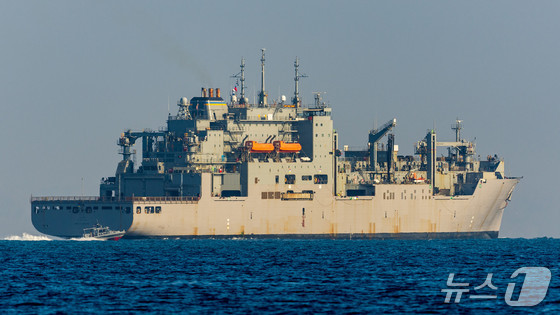
The U.S. shipbuilding industry is intensifying efforts to secure Maintenance Support Agreements (MSRAs) for the Navy’s ship maintenance, repair, and overhaul (MRO) operations. Industry leaders in specialized vessels, including HD Hyundai and Hanwha Ocean, as well as smaller shipyards, are all vying for MSRA certification.
This push is seen as preparation for the expansion of the U.S.-Korea shipbuilding cooperation Make American Shipbuilding Great Again (MASGA) project. Long-term, these companies aim to position themselves for potential involvement in the proposed Golden Fleet initiative.
Following HD Hyundai and Hanwha Ocean’s lead, Samsung Heavy Industries has now entered the fray. Industry sources revealed on Wednesday that Samsung Heavy Industries has initiated MSRA acquisition preparations, spearheaded by its U.S. operations division. The company intends to compile the necessary documentation to apply for MSRA certification with the U.S. Navy’s Supply Systems Command in the near future.
The MSRA is a coveted qualification awarded by the Supply Systems Command after a comprehensive evaluation of private shipyards. This assessment covers repair capabilities, financial stability, technical expertise, quality control measures, safety protocols, and security systems. MSRA-certified shipyards gain a five-year window to bid on U.S. Navy combat ship MRO contracts.
In August of last year, Samsung Heavy Industries formed a strategic alliance with Vigor Marine Group, a specialist in U.S. Navy support ship MRO. Initially, the plan was to collaborate with Vigor Marine without MSRA certification. However, the decision to pursue the qualification was made to enhance their competitive edge.
HJ Shipbuilding & Construction, a powerhouse in specialized vessels, and SK Ocean Plant, an offshore plant expert, are on the cusp of securing MSRA certification. Both firms anticipate finalizing their licenses soon, having successfully passed the U.S. Navy’s port security assessment earlier this month.
K Shipbuilding, a mid-tier shipyard, is also gearing up for MSRA certification. Meanwhile, HJ Shipbuilding & Construction has already commenced MRO operations on the United States Naval Ship (USNS) Amelia Earhart, a 40,000-ton logistics support vessel under the U.S. Navy’s Military Sealift Command.
HD Hyundai Heavy Industries and Hanwha Ocean blazed the trail by obtaining MSRA certifications in July 2024, marking their official entry into the U.S. Navy’s ship MRO sector. Since then, HD Hyundai Heavy Industries has clinched two U.S. Navy MRO contracts, while Hanwha Ocean has secured five. Including HJ Shipbuilding’s contribution, the total stands at eight MRO contracts.
U.S. MRO Market Valued at 20 trillion KRW (13.5 billion USD): Positioning for Future Shipbuilding Contracts
The fervent pursuit of U.S. Navy MSRA certification by both major players and smaller shipyards in the Korean maritime industry is driven by the anticipated growth in the MRO market. While MSRA certification isn’t mandatory for non-combat vessel MRO, it’s seen as a strategic move to target the lucrative combat ship MRO sector in the future.
The U.S. naval MRO market is estimated at approximately 20 trillion KRW (about 13.5 billion USD), based on relevant departmental budgets. Market growth projections are optimistic. Intel Corporation reports that the global naval vessel MRO market is expected to expand from 61.38 billion USD last year to 71.62 billion USD by 2030, growing at an annual rate of 3.13%.
The MRO sector’s appeal lies in its stability as a revenue stream, accelerating market entry efforts. Unlike the volatile new ship market with its billion-dollar contracts, MRO generates consistent demand based on operational vessels, making it more resilient to economic fluctuations. HD Hyundai Heavy Industries and Hanwha Ocean have even boosted profitability by identifying additional maintenance requirements during MRO processes.
Korean shipyards are leveraging MSRA certifications to build credibility in MRO operations, with an eye on future shipbuilding contracts. This aligns with the current administration’s plans to construct a Golden Fleet to maintain and enhance maritime supremacy.
An industry insider noted that MSRA certification demonstrates the ability to meet the U.S. Navy’s exacting standards. MRO experience provides invaluable insights into ship structures and designs, giving us a competitive edge for future new build contracts
Han Seung-han, an analyst at SK Securities, predicts that the Golden Fleet initiative will significantly boost U.S. Navy ship procurement budgets. Subcontracting to Korean shipyards, with their optimized facilities and skilled workforce, is the most effective way to address potential delays and cost overruns. Future budgets are likely to factor in overseas shipyard construction capabilities.