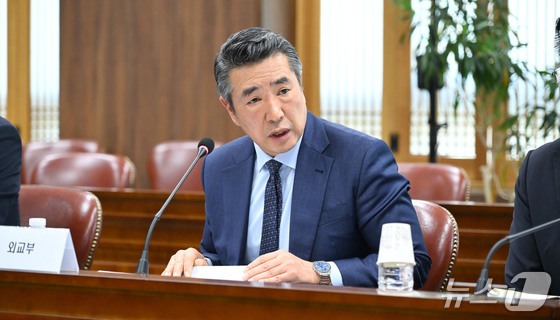
Last week, Lim Gap-soo, the government representative of the U.S.-Korea Nuclear Cooperation Interagency Task Force (TF), visited the U.S. and met with senior officials from the State Department and the Department of Energy, as confirmed on Monday. Both parties reportedly reached a consensus to conduct practical discussions regarding the revision and adjustment of U.S.-Korea nuclear cooperation as soon as possible.
According to a comprehensive report by News1, Representative Lim’s U.S. visit lasted three days, starting from January 15. During this time, he met with personnel responsible for nuclear and non-proliferation matters at the State Department and the Department of Energy. It’s worth noting that this meeting was not for official negotiations between the U.S. and South Korea, but rather a courtesy visit to establish initial contact.
Lim reportedly engaged in discussions with Christopher Yeaw, the Deputy Assistant Secretary of State for Arms Control and Nonproliferation, and other officials at the Deputy Secretary level from the Department of Energy. These talks aimed to outline the direction of future cooperation. Yeaw, appointed last December, is a key figure overseeing nuclear non-proliferation and nuclear policy within the State Department.
A government official stated that similar to the communication that took place during National Security Office Director Wi Sung-lac’s visit last December, it reaffirmed its position that the U.S. and South Korea should hold practical negotiations in Seoul as soon as possible. The official added that it reiterated that meeting early is a principle it adheres to – the sooner, the better.
However, the official U.S. counterpart who will communicate directly with Representative Lim has not yet been determined. A government official noted that the U.S. counterpart has not been decided yet, and added that it expects this to be established before the practical discussions begin in Seoul.
Earlier, on January 9, the South Korean government officially launched the U.S.-Korea Nuclear Cooperation Interagency Task Force (TF). This move signaled the beginning of serious discussions with the U.S. to expand South Korea’s authority for uranium enrichment and spent nuclear fuel reprocessing.
Currently, South Korea must obtain consent from the U.S. on a case-by-case basis for uranium enrichment below 20% and for spent nuclear fuel reprocessing. The country is exploring ways to transition this to a comprehensive consent framework, similar to Japan’s model. Instead of seeking case-by-case consent, they aim to establish a plan for specific periods and negotiate with the U.S. to autonomously conduct the necessary uranium enrichment and spent nuclear fuel reprocessing during those periods.
The TF includes participation from key government bodies and institutions, including the Ministry of Foreign Affairs, the Ministry of Science and Information and Communications Technology (ICT), the Ministry of Climate, Energy, and Environment, the Ministry of Trade, Industry and Energy, the Nuclear Safety Commission, the Korea Atomic Energy Research Institute, Korea Hydro & Nuclear Power, and the Nuclear Control Technology Institute.