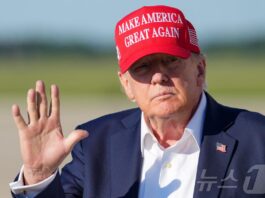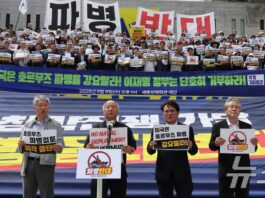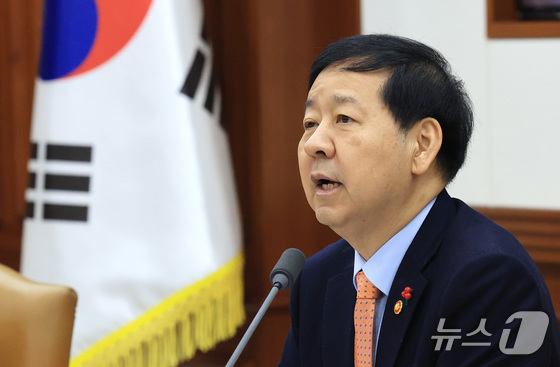
President Donald Trump has criticized the South Korean National Assembly for delaying legislation on a special U.S. investment law, threatening to raise tariffs on automobiles and other goods from 15% to 25%. In response, the ruling party and government launched emergency measures on Tuesday.
The Democratic Party and the government planned to discuss countermeasures during a meeting originally scheduled for 11 a.m. that day on livelihood policies. While Deputy Prime Minister and Finance Minister Koo Yun Cheol couldn’t attend due to a Cabinet meeting, the Vice Finance Minister was set to brief lawmakers on the situation.
Later that day at 4 p.m., Deputy Prime Minister Koo was scheduled to meet with key lawmakers, including Strategy and Finance Committee Chair Im I Ja from the People Power Party, to urge swift passage of the special bill for U.S.-Korea strategic investment management.
An official from the opposition People Power Party criticized the government and the ruling party for a lack of follow-up actions, saying the party had insisted on National Assembly ratification. In contrast, the government and the ruling party claimed it was unnecessary. The official added that although they had acted as if they would simply draft the bill, no further action had been taken.
The official further said that as the minority party, they had received no requests from the Democratic Party to discuss the bill or take any action regarding National Assembly approval.
The Democratic Party maintained that the U.S. hadn’t raised concerns about the legislative delay and that time constraints prevented the bill’s processing, assuring that normal deliberation procedures would be followed.
A Democratic Party representative said via text message that the party had received no practical appeals from the United States regarding the legislative delay, adding that the U.S.–Korea agreement concerned the introduction of the bill and did not include a specific timeline for its passage.
He further explained that five U.S.–Korea investment bills had already been introduced and that, after the deliberation period, they would naturally move into the review process. He noted that December had been occupied with tax reviews and January with confirmation hearings, leaving no time for individual bill reviews. He added that future deliberations would proceed in accordance with standard procedures.
On Monday, President Trump announced via Truth Social that he would raise reciprocal tariffs on automobiles, wood, and pharmaceuticals from 15% to 25%, citing the South Korean National Assembly’s failure to enact a trade agreement.
The trade agreement and National Assembly approval that Trump referred to likely concern the special U.S. investment law that South Korea must pass to fulfill its investment commitments to the U.S.
Following their summit in Gyeongju, South Korea, on October 29 last year, the two countries released a joint fact sheet on November 13 that summarized their security and trade agreements.
On November 14, the day after the fact sheet’s release, both nations signed a Memorandum of Understanding (MOU) on strategic investments. They agreed to retroactively apply tariff reductions from the first day of the month in which the implementation bill was submitted to the South Korean National Assembly.
Subsequently, on November 26, the Democratic Party introduced the special U.S. investment law, led by then-floor leader Kim Byung Ki. The bill proposes establishing a U.S.-Korea Strategic Investment Fund to manage $200 billion in strategic industrial investments, as well as a $1.5 billion shipbuilding cooperation fund.
The U.S. retroactively reduced tariffs to 15% on December 4, following official publication.
However, since its submission to the Strategy and Finance Committee on November 27 last year, the bill has been stalled due to partisan disagreements over its approval in the National Assembly. With the opposition People Power Party’s committee chair, passage under the ruling party’s leadership remains challenging.