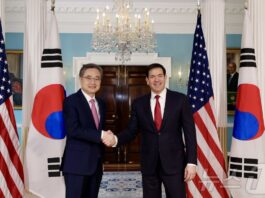
On Wednesday, South Korean Foreign Minister Cho Hyun met with U.S. Secretary of Energy Chris Wright to discuss securing authority for nuclear enrichment and reprocessing as a preliminary step towards building nuclear-powered submarines.
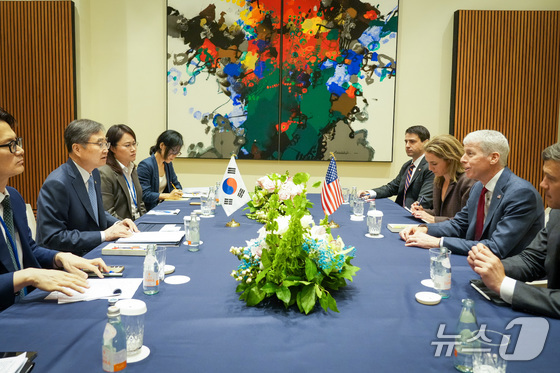
The Foreign Ministry announced that Minister Cho met with Secretary Wright during the U.S. State Department’s Ministerial Meeting on Critical Minerals held in Washington, D.C.
During their meeting, the two sides discussed the implementation of the Joint Fact Sheet from the U.S.-South Korea summit and explored ways to enhance nuclear cooperation between the two countries.
The Foreign Ministry of South Korea stated that the two ministers reaffirmed the need for swift, concrete progress in enrichment, reprocessing, and cooperation on nuclear-powered submarines, as outlined in the Joint Fact Sheet.
They also agreed to promptly initiate working-level discussions to advance these efforts.
During the meeting, Minister Cho expressed his expectation that expanding cooperation in enrichment and reprocessing would further strengthen strategic nuclear collaboration between South Korea and the U.S., urging the U.S. side to pursue such cooperation.
In response, Secretary Wright conveyed his commitment to actively cooperate and maintain close communication to achieve tangible results in expanding cooperation in these areas, according to the Foreign Ministry.
Last October, during the U.S.-South Korea summit in Gyeongju, South Korean President Lee Jae Myung and U.S. President Donald Trump agreed to introduce nuclear-powered submarines for South Korea, which was included in the Joint Fact Sheet released the following month.
The nuclear-powered submarine program is a long-standing aspiration of the South Korean military. Due to the nuclear cooperation agreement with the United States, South Korea cannot produce or use highly enriched uranium for military purposes, necessitating a revision of this agreement first.
Additionally, the Foreign Ministry said both sides had positively evaluated the recent collaboration between the two countries’ nuclear power companies and agreed to communicate and cooperate closely to promote private-sector nuclear cooperation, including joint ventures in third countries.