


Google faces a May 5, 2026, deadline to submit supplementary documents for its request to export high precision map data, drawing attention to whether U.S. pressure tied to a planned 25 percent tariff increase could influence South Korea’s decision under its digital regulation framework.
IT industry sources said Google is expected to submit revised materials seeking approval to export 1:5,000 scale maps, partially accepting government conditions after consultations with authorities including the Ministry of Land, Infrastructure and Transport, after which the government plans to convene a review committee to assess findings and make a final decision.
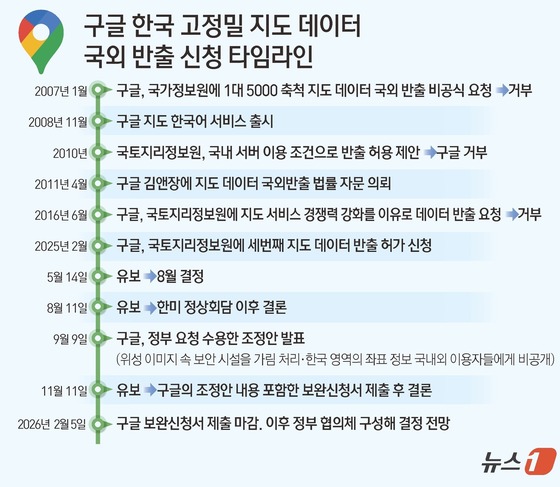
The government has postponed Google’s request three times in May, August, and November 2025 due to insufficient documentation, and while Google expressed willingness to comply with security and coordinate display restrictions, it continues to oppose establishing a domestic data center, a key requirement that could prolong deliberations amid Korea U.S. trade and tariff talks.
Apple’s similar request was also deferred in December 2025, and although Apple accepted all government conditions including building a domestic data center, authorities have played down expectations of swift approval.
On May 4, 2026, the Ministry of Land, Infrastructure and Transport said exports of high precision map data are determined through an export review committee under the Spatial Information Management Act and emphasized that no decision has been finalized.
The formalization of a U.S. move to raise mutual tariffs to 25 percent is heightening concerns that pressure could spill over into South Korea’s high precision map export decision, with government sources on May 5, 2026, saying the administration of Donald Trump is preparing to publish a notice increasing tariffs on South Korean imports from 15 percent to 25 percent.
The United States has consistently urged South Korea not to discriminate against U.S. firms under its digital regulation framework, and a joint fact sheet on tariff negotiations released on November 14, 2025, stated that both sides agreed in principle that South Korea would not discriminate against U.S. companies in digital service regulations and would facilitate cross border data transfers necessary for service delivery.
As Washington continues to use tariff hikes as leverage in digital regulation talks, industry observers say a U.S. favorable outcome in negotiations over high precision map exports cannot be ruled out.
Last month, the United States sent a letter to South Korea’s Deputy Prime Minister and Minister of Science and ICT urging compliance with the Korea U.S. fact sheet, and while details were not disclosed, the IT industry believes high precision map exports were likely cited as part of the U.S. list of digital trade barriers.
Opponents argue that allowing high precision map exports could result in losses of up to 197 trillion KRW (147.75 billion USD) over 10 years and stress that fair competition and domestic industry protection must remain the priority.

Continued U.S. pressure on trade and tariffs is increasing concerns that South Korea may conditionally approve high precision map exports to Google despite the company not operating a domestic data center, a scenario industry officials say cannot be fully ruled out.
Industry insiders argue that requiring foreign companies to establish domestic data centers should be prioritized to limit potential economic and security risks associated with map exports.
At a recent policy discussion, Professor Jeong Jin Do of Korea National University of Education cited research estimating that high precision map exports could generate losses of 150 trillion to 197 trillion KRW (112.5 billion to 147.75 billion USD) over the next 10 years across sectors including mapping, platform services, mobility, and construction.
Experts say Google’s refusal to build a domestic data center constitutes unfair competition, as overseas data processing heightens the risk of sensitive information leaks and complicates post management measures such as security inspections and sanctions.
Industry representatives note that domestic providers such as Naver and Kakao are subject to strict security compliance requirements including dedicated equipment and protected zones, arguing that foreign firms should meet the same standards by establishing domestic data centers and accepting post management oversight.