

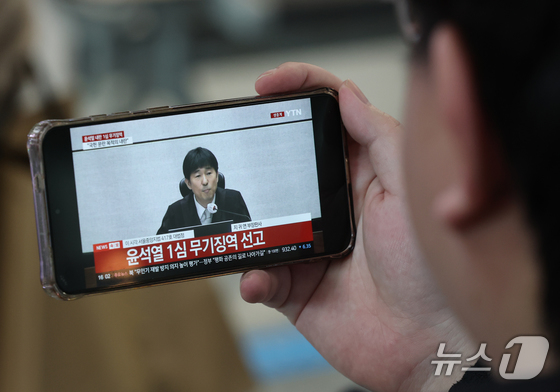
On Thursday, former President Yoon Suk Yeol was sentenced to life imprisonment for leading a rebellion. As most first-instance proceedings against key defendants related to the December 3 martial law have concluded, the Seoul High Court is poised to commence the second round of the rebellion trial.
The 25th Criminal Division of the Seoul Central District Court, presided over by Judge Ji Kwi-yeon, handed down a life sentence to former President Yoon on charges of leading a rebellion.
Kim Yong-hyun, the former Minister of National Defense identified as the second-in-command of the martial law, received a 30-year prison term, while former Army Intelligence Commander Noh Sang-won, accused of involvement in the martial law’s covert operations, was sentenced to 18 years. Kim immediately appealed the first-instance ruling on the day of the verdict.
Former Police Chief Jo Ji-ho, charged with participating in the National Assembly blockade, was sentenced to 12 years; former Seoul Police Chief Kim Bong-sik received 10 years; and former National Assembly security chief Mok Hyun-tae was given a 3-year sentence.
In response to the verdict, Yoon’s team criticized the court, stating in a press release that they’re in such despair that we cannot even express the minimum respect for the judiciary’s judgment.
The special prosecutor’s team, led by Prosecutor Cho Eun-seok, also expressed significant disappointment regarding the factual findings and sentencing, suggesting that both sides are likely to appeal the first-instance ruling.
If both Yoon’s team and the special prosecutor file appeals, the rebellion case will likely be assigned directly to the Seoul High Court’s division specializing in rebellion, foreign exchange, and insurrection cases.
The rebellion special prosecutor law mandates that the second and third-instance rulings must be issued within three months of the first-instance verdict, so the appellate judgment is expected before May.
The Seoul High Court’s rebellion division comprises Criminal Division 1 (Chief Judge Yoon Sung-sik, Min Seong-cheol, Lee Dong-hyun) and Criminal Division 12 (Judges Lee Seung-cheol, Jo Jin-goo, Kim Min-ah).
The cases of former Prime Minister Han Duck-soo and former Minister of the Interior and Safety Lee Sang-min, sentenced to 23 years and 7 years respectively for charges related to significant duties during the rebellion, are also expected to be assigned to the rebellion division.
The first-instance courts handling rebellion-related cases unanimously determined that the December 3 martial law constituted rebellion under criminal law.
The 25th Criminal Division of the Seoul Central District Court, which examined former President Yoon’s rebellion charges, referenced historical events such as King Charles I of England’s dissolution of Parliament to explain the concept of rebellion aimed at undermining the constitution.
They argued that a president could potentially engage in rebellion aimed at undermining the constitution, and that individuals involved in riotous acts need only share an implicit awareness of the purpose to undermine the constitution for the elements of the rebellion charge to be satisfied.
To establish the crime of collective rebellion, individuals must not only be involved in actions related to martial law but must also recognize and share the purpose of undermining the constitution. Even if their awareness or participation is implicit, or if they recognize or share it after the fact, they can still be charged with rebellion.
The court also determined that the declaration and announcement of the December 3 martial law, actions to block the National Assembly, the organization of arrest teams targeting lawmakers and politicians, and attempts to seize the Central Election Management Committee’s servers and arrest employees all constituted riotous acts in themselves.
However, the court noted mitigating factors, including the apparent lack of meticulous planning, efforts to minimize the use of force, and the failure of most plans.
This contrasts with the 33rd Criminal Division of the Seoul Central District Court, which handled former Prime Minister Han’s case, characterizing the December 3 martial law as a top-down rebellion without considering the limited scope or duration of the resulting harm.
In the appeals process, Yoon and his team are expected to vigorously contest the establishment of rebellion charges against defendants involved in the December 3 martial law.
The special prosecutor’s team is likely to challenge the factual basis regarding the timing of the martial law conspiracy, drawing on evidence from former Army Intelligence Commander Noh’s notebook.
Previously, Yoon’s team had signaled plans to argue procedural unfairness, claiming the court’s rebellion division was unconstitutional. However, given the principle of random case assignment, it is unlikely the court will entertain such arguments.