

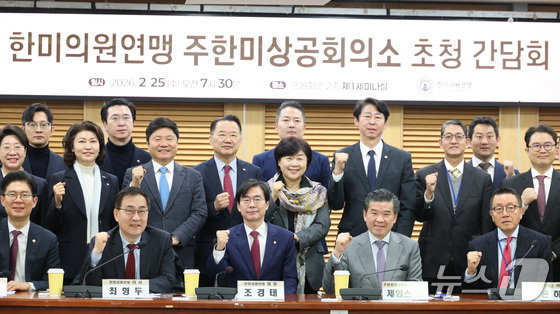
A delegation from the U.S.-Korea Congressional Alliance, comprising lawmakers from both parties, will visit the U.S. on March 23. They plan to discuss follow-up measures to the U.S.-Korea tariff negotiations, including the Special Act on U.S. Investment, and address current issues regarding Korean companies’ investments in America. The group also aims to establish a U.S.-Korea Congressional Caucus to enhance cooperation with the U.S. Congress.
Rep. Cho Kyung-tae of the People Power Party, who chairs the U.S.-Korea Congressional Alliance, announced on the 4th during a meeting with the head of the Trade Negotiation Office at the National Assembly that he will lead a congressional delegation to the U.S. on March 23 to meet with key figures in Congress and the administration.
Cho emphasized that they’re facing a 200 billion USD investment opportunity in the U.S. and 150 billion USD in shipbuilding cooperation. To ensure these commitments are effectively implemented and boost the economy, the National Assembly must provide robust support through legislation, including the Platform-Related Act and the Special Act on U.S. Investment.
Rep. Kim Young-bae of the Democratic Party, who serves as secretary of the U.S.-Korea Congressional Alliance, stated that it aims to organize a U.S.-Korea Congressional Caucus in Washington to develop more structural measures for engaging with the U.S. Congress. It hopes to collaborate with lawmakers and committees leading trade and security cooperation issues for more organized efforts in the future.
The delegation, led by Rep. Cho Kyung-tae, will include six members, with Rep. Min Hong-cheol serving as deputy leader. Alliance members from both parties will meet with U.S. senators and representatives to discuss follow-up measures to the U.S.-Korea tariff negotiations, the Strait of Hormuz situation, and issues related to Coupang’s U.S. investments.
Rep. Cho Jeong-hoon of the People Power Party, another secretary of the U.S.-Korea Congressional Alliance, remarked that he hopes the government will critically examine its trade strategy for any flaws, communicate openly with the National Assembly about its needs, and report concrete, accountable outcomes.
Yeo Han-koo, head of the Trade Negotiation Office at the Ministry of Trade, Industry and Energy, emphasized that the National Assembly plays a crucial role in stabilizing U.S.-Korea trade relations. It’s particularly important that the Special Act on U.S. Investment, currently under discussion in the Assembly, passes in a timely manner.
Yeo also stressed that it’s essential to accurately explain our policy intentions regarding various bills being discussed in the National Assembly to prevent misunderstandings.