

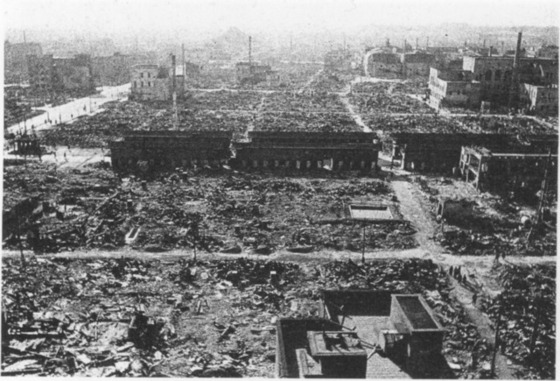
On the night of March 10, 1945, a massive shadow of death fell over Tokyo, Japan. Over 300 B-29 Superfortress bombers belonging to the U.S. Army Air Forces (USAAF) penetrated at low altitude and began dropping thousands of tons of napalm bombs (M69 incendiary bombs).
This marked the beginning of the Tokyo Firebombing (Operation Meetinghouse). It served as a powerful warning to Japan’s leadership that the war’s end was imminent. Simultaneously, it altered the course of World War II and stands recorded as one of the most devastating air raids in human history.
Until then, the U.S. had insisted on daytime precision bombing targeting military factories, but jet streams and worsening weather conditions yielded limited results. Consequently, General Curtis LeMay completely revised the strategy. He adopted a scorched-earth strategy, exploiting the characteristic dense concentration of wooden buildings in Japanese cities: dropping incendiary bombs at low altitude during nighttime to burn entire cities to the ground.
The primary target of the air raid was the densely populated Shitamachi district east of Tokyo. The incendiary bombs released a sticky gel-like fuel upon contact with buildings, igniting unquenchable fires. Gusts reaching 40 km/h (about 25 mph) fueled the flames into a massive firestorm, consuming oxygen and heating the atmosphere to over 1,000 degrees Celsius (about 1,832 Fahrenheit).
Citizens who jumped into rivers lost their lives in the boiling water, while those who sought refuge in basements suffocated to death. In a single night, approximately 100,000 people perished, and over a million were displaced. Roughly one-quarter of Tokyo’s city center was reduced to complete ashes.
While the Tokyo firebombing crippled Japan’s war-making capabilities, it was not free from moral criticism as a massacre of civilians. Even LeMay, who led the operation, remarked that if they lose this war, they will be tried as war criminals. Furthermore, it served as a prelude to the atomic bombings of Hiroshima and Nagasaki later that same August.