The Donald Trump administration in the United States has officially launched a Section 301 investigation targeting unfair trade practices from 16 economic entities, including South Korea. This move intensifies pressure on digital policies in South Korea.
The U.S. government has consistently criticized discussions around online platform regulations and the institutionalization of network usage fees as discrimination against American companies. Consequently, the Section 301 investigation, which threatens retaliatory tariffs, poses significant challenges for the advancement of South Korea’s digital policies.
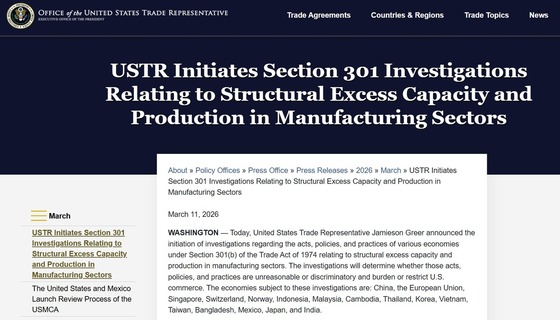
On Thursday, according to reports from the IT industry and government sources, the Office of the U.S. Trade Representative (USTR) announced on Wednesday that it had initiated a Section 301 investigation against South Korea and 15 other economic entities.
The investigation includes countries such as China, the European Union (EU), Japan, Mexico, Singapore, Switzerland, Norway, Indonesia, Malaysia, Cambodia, Thailand, Vietnam, Taiwan, Bangladesh, and India. If the policies of these entities are deemed discriminatory against U.S. commerce, the U.S. plans to respond with tariffs and other measures.
South Korea’s digital policies are likely to come under scrutiny. Last month, when the USTR announced plans for a new global tariff of 10% alongside the Section 301 investigation, it specifically mentioned discrimination against U.S. digital goods and services, as well as the digital services tax, as areas of concern.
During a pre-briefing on Wednesday, USTR representative Jamieson Greer stated that it will engage in discussions with our trading partners regarding the digital services tax issue as per the law, adding that these issues could lead to further investigations in the future.
The USTR will accept public comments from March 17 to April 15. They plan to hold public hearings starting May 5 and will consider a range of responses, including imposing tariffs, service fees, and negotiation demands, based on the investigation’s findings.
The government’s conditional approval on February 27 for Google to export high-precision map data, a notable non-tariff barrier in the digital sector, has resolved that particular issue. However, the fate of the Online Platform Act pending in the National Assembly, renewed discussions on network usage fees following President Lee Jae Myung’s inauguration, and restrictions on foreign ownership in critical infrastructure companies remain uncertain.
Previously, the USTR identified various trade barriers in its 2025 National Trade Estimate Report (NTE), including regulations against online platform monopolies, network usage fees imposed by domestic Internet Service Providers (ISPs) on global content providers (CPs), barriers to entry for public market cloud services, and restrictions on foreign investment in telecommunications and broadcasting.
The online platform policy, commonly known as the Online Platform Act, currently has 19 bills proposed in the National Assembly. The U.S. has expressed concerns that these bills, aimed at preventing monopolies by dominant market players, excessively regulate its big tech companies like Google, Apple and Meta. Although President Lee revived discussions on the Online Platform Act as a campaign promise, increasing trade pressure from the U.S. has slowed its progress.
The South Korean telecommunications industry’s push to institutionalize network usage fees for large traffic providers like Google and Netflix is another U.S. concern. This issue, proposed by President Lee, is addressed in a bill known as the Network Free-Riding Prevention Act introduced in the National Assembly.
Additionally, the security certification system for cloud services in the public sector and restrictions on foreign ownership in domestic broadcasting and telecommunications policies are cited as non-tariff barriers obstructing U.S. companies’ market entry. The recent passage of the false information eradication law, which penalizes platforms like YouTube for distributing misinformation, has also drawn U.S. scrutiny.
Meanwhile, the investigation into Coupang’s personal data leak, which triggered the Section 301 investigation, has become a growing concern for the South Korean government. The Personal Information Protection Commission, currently investigating Coupang, is nearing the conclusion of its inquiry.
Previously, Coupang’s U.S. investors withdrew their petition for a Section 301 investigation, arguing that the South Korean government’s actions discriminated against Coupang. However, this coincides with the USTR’s broader Section 301 investigation, suggesting that the U.S. government intends to examine the Coupang situation at a national level, thereby increasing pressure on South Korea.