

The Blue House is closely monitoring the repercussions of the Middle East conflict. Despite President Donald Trump’s repeated hints at the possibility of ending the war, there’s ongoing uncertainty in energy supply as long as the Strait of Hormuz, a crucial global oil transportation route, remains blocked. As a result, the administration remains vigilant, seeking alternative supply sources.
The Blue House is also paying close attention to the message President Trump might deliver regarding the Middle East war in his address to the nation, scheduled for 10:00 a.m. Korean time on Thursday.
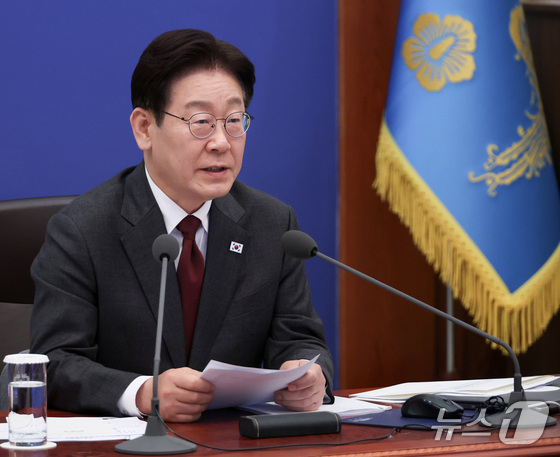
According to the Blue House on Thursday, President Lee Jae Myung, while presiding over an emergency economic review meeting at the Blue House the previous day, instructed officials to proactively identify and catalog all items expected to be affected by the war. He also ordered a thorough daily check on supply conditions, price trends, and any unusual signs.
President Lee particularly emphasized the need to actively explore alternative overseas supply sources through foreign missions. This all-out response comes as South Korea’s energy supply has been hit due to the blockade of the Strait of Hormuz, a key logistics route, as a result of the Middle East war.
As the Middle East conflict enters its fifth week, the South Korean economy, which heavily relies on energy imports, faces a crisis. The Ministry of Industry and Commerce has elevated the oil resource security crisis alert to caution as of midnight today, deciding to strengthen energy demand management. This is the first time the crisis alert has been raised to ‘caution’ since the implementation of the National Resource Security Special Act in February last year.
This indicates that the domestic oil import and inventory situation is not favorable. Recently, there was increased hope for domestic imports as the U.S. administration temporarily eased sanctions on Russian oil and petroleum products already shipped and at sea. However, even this appears to be challenging.
A high-ranking Blue House official stated that Russian oil is only possible under limited conditions, and most of it already has predetermined destinations. Realistically, we should consider domestic imports to be difficult.
Trump’s Address to the Nation Today… Hormuz Risk Persists Despite Possibility of War’s End
The Blue House is currently focused on President Donald Trump’s address to the nation today. Trump is scheduled to deliver a speech at 9:00 p.m. to update the public on the latest developments in the Iran war.
Diplomatic circles widely anticipate that President Trump might hint at the possibility of a ceasefire or an end to the war with Iran during his speech.
Related to this, on Wednesday morning before his speech, Trump claimed on his social media platform, Truth Social, that the new Regime President of Iran, who is far less radical and much smarter than his predecessors, has just requested a ceasefire from the U.S.
He continued that it will consider it when the Strait of Hormuz is open, free, and cleared, adding that until then, it will completely devastate Iran or, as they say, send them back to the Stone Age.
However, even if President Trump suggests the possibility of ending the war in this speech, the prevailing view is that energy supply disruptions will continue for the time being. This is because Iran holds the key to opening the Strait of Hormuz. Iran immediately denied Trump’s ceasefire request claim as false and baseless, countering that the war will continue until the aggressors (U.S. and Israel) are punished and fully compensate Iran.
Furthermore, during an executive order signing ceremony at the White House on Tuesday, Trump stated that it will withdraw soon, and regarding the Strait of Hormuz, he said that it’s not its responsibility. They (countries dependent on the strait) can go there directly and protect themselves.
This is why observers predict that even if President Trump officially announces the end of the war soon, it will be difficult to resolve the Strait of Hormuz issue. Another problem is that the energy production infrastructure of major Gulf countries has been significantly damaged during the war.
In response, the Blue House is strengthening its emergency response system and focusing all efforts on securing energy. President Lee’s order to explore alternative overseas supply sources is interpreted in the same context.
President Lee also instructed the Ministry of Oceans and Fisheries and the Ministry of Foreign Affairs to consult with each other and report on the possibility of transporting oil through the Red Sea, if shipping companies desire, for the 26 South Korean-flagged vessels currently stranded in the Strait of Hormuz.
Meanwhile, the government is internally considering expanding energy demand control to the private sector. Currently, measures such as strengthening the five-day rotation system for vehicles are being implemented, primarily in the public sector.
At yesterday’s meeting, President Lee stated that cooperation and solidarity in times of crisis become sustainable assets for our society, and earnestly requested that as such, he asks all economic entities to take one more step together.