

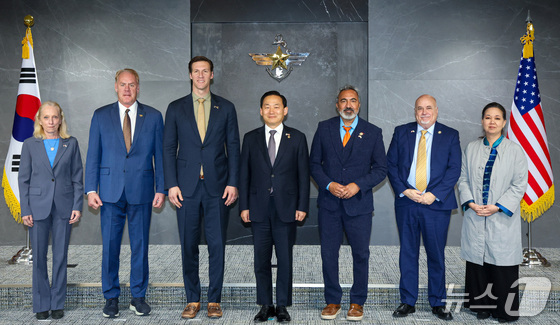
On Thursday, Deputy Defense Minister Lee Doo-hee met with a U.S. congressional delegation at the Ministry of National Defense headquarters in Seoul’s Yongsan district. He urged the American lawmakers to actively support and cooperate in the transfer of wartime operational control (OPCON).
The six-member delegation included Republican Representatives Pat Harrigan and Ryan Zinke, along with Democratic Representatives Ami Bera, Mark Pocan, Mary Gay Scanlon, and Jill Tokuda. These lawmakers are part of the Congressional Study Group on Korea (CSGK), established in February 2018, which now boasts 136 members from both chambers of Congress.
Deputy Minister Lee expressed his deep appreciation for the delegation’s interest in U.S.-Korea affairs. He outlined the South Korean government and military’s efforts towards OPCON transition, emphasizing that this shift should strengthen the Republic of Korea (ROK)-U.S. alliance and enhance the combined defense system.
The OPCON transfer process involves three stages: Initial Operational Capability (IOC), Full Operational Capability (FOC), and Full Mission Capability (FMC). Each stage requires evaluation and verification. The two allies have already completed the FOC evaluation and aim to finalize the verification process by the end of this year.
Lee also sought bipartisan support from U.S. lawmakers on key issues such as maintenance, repair, and overhaul (MRO) operations for naval vessels and the development of nuclear-powered submarines. Both sides agreed to maintain close cooperation to further strengthen the U.S.-Korea alliance.