

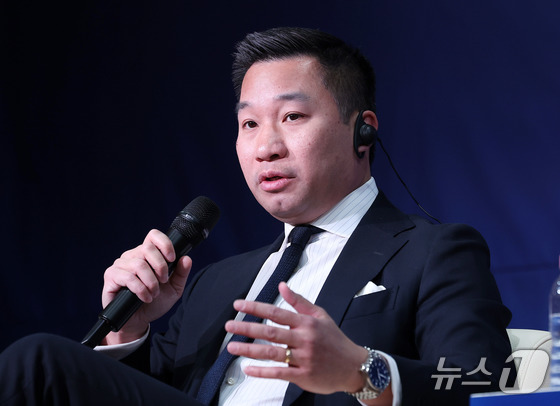
On Thursday, Alex Wong, former Deputy Assistant to the U.S. National Security Advisor and current President of Hanwha Group, who spearheaded North Korea negotiations during the first Donald Trump administration, offered his insights. He predicted that given the evolving strategic landscape and Trump’s policies, there’s a high likelihood of continuity in certain aspects, regardless of whether the next administration is Republican or Democratic.
Speaking at the Sejong National Strategy Forum on, A Potential Second Trump Term and South Korea’s Foreign and Security Strategy, Wong provided a sobering assessment. He noted that the 25-year period following the Cold War’s end was an exceptional era of U.S. global leadership. However, he emphasized that they’ve now entered a markedly different strategic environment, characterized by intensified great power competition. It can no longer rely on 1990s-era approaches, he cautioned.
Wong highlighted how China’s economic and military ascendancy, coupled with Russia’s aggressive posturing, have fundamentally reshaped the international order. He added that these shifts are compelling the U.S. and its allies to inevitably recalibrate their policies and strategies.
He further explained that Trump’s policies, transcending personal style, are resonating within the U.S. as they address these structural changes. It’s witnessing adjustments across trade, defense, and broader industrial policies, Wong noted.
Regarding economic and industrial policy shifts, Wong pointed out a growing trend. There’s a clear move away from efficiency-driven global division of labor towards securing domestic production bases for strategic industries like pharmaceuticals, shipbuilding, defense, and critical minerals, he said. Wong emphasized that it has entered an era where supply chain resilience and strategic autonomy are paramount.
On defense matters, Wong remarked that Trump’s push for increased defense spending, both domestically and among European and Asian allies, aims to distribute global security burdens more equitably. This is a necessary adaptation to the current strategic environment, he asserted.
Assessing Trump’s leadership, Wong characterized it as demonstrating strategic boldness that breaks from conventional diplomatic norms. He noted Trump’s proactive approach to long-standing strategic issues involving Iran, Venezuela, and Cuba.
Wong also underscored that these strategic shifts actually enhance the Republic of Korea (ROK)-U.S. Alliance’s importance. He stressed that the alliance must evolve beyond a mere military and security partnership. It should expand and deepen by leveraging South Korea’s strengths in technological cooperation, industrial base development, and bolstering supply chain resilience.
In conclusion, Wong stated that while the global order is in flux, the ROK-US Alliance will play an even more pivotal role. It needs to develop the alliance in a more strategic and multifaceted direction.
Wong’s credentials include serving as Deputy Assistant Secretary of State for North Korea and Special Representative for North Korea during Trump’s first term. He played a key role in the Singapore and Hanoi summits and contributed to the Free and Open Indo-Pacific Strategy. Following Trump’s re-election, he briefly served as Deputy National Security Advisor at the White House’s National Security Council before resigning in May of last year.