

As calls for defense autonomy grow within the European Union (EU), the potential benefits for South Korean defense companies are drawing attention. This comes in the wake of President Donald Trump’s comments about the possibility of U.S. withdrawal from NATO (North Atlantic Treaty Organization) during the ongoing conflict with Iran.
While the likelihood of a U.S. exit from NATO remains low, persistent concerns about security gaps are fueling expectations that Europe will intensify its rearmament efforts, focusing on ground defense systems and ammunition. Industry watchers are keen to see if the domestic defense industry can successfully expand exports despite Europe’s “Buy European” policy.
Trump’s NATO “Paper Tiger” Comments Accelerate European Defense Independence
According to foreign media and industry sources on Monday, President Trump stated in an interview with the British daily Telegraph on Wednesday that NATO’s non-participation in the Iran conflict left no room for reconsideration regarding U.S. withdrawal. He criticized the alliance, describing it as ineffective.
Trump’s remarks came as NATO and European member countries declined to participate in U.S. operations to reopen the Strait of Hormuz. NATO expressed reluctance to comply with Trump’s request to deploy warships, and Poland refused to send Patriot missile systems to the Middle East.
Furthermore, Spain reportedly denied U.S. military aircraft passage through its airspace, Italy refused to allow U.S. forces to use its Sicilian air base, and France did not permit Israel, which is engaged in the conflict alongside the U.S., to use its airspace.
U.S. skepticism about NATO is not new, but the differences in stance have become more pronounced following the Iran conflict. During a state visit to South Korea, French President Emmanuel Macron criticized Trump’s remarks, warned that ongoing uncertainty about participation could undermine the alliance’s foundation.
Most experts currently believe that the likelihood of a U.S. withdrawal from NATO is low. To exit, the U.S. would need a two-thirds majority vote in the Senate, according to the National Defense Authorization Act (NDAA). Given the bipartisan support for the transatlantic alliance between the U.S. and Europe, this scenario seems unrealistic.
However, Trump’s potential choices, such as troop reductions that could weaken NATO, could heighten tensions in Europe. According to the political media outlet Politico, European diplomats and EU officials have said that NATO is paralyzed and cannot even hold meetings, and that the alliance is on the brink of collapse.
Cha Woon Sam, a defense analyst at Hana Securities, noted that Trump’s remarks could raise doubts about the U.S. commitment to collective defense, increasing the need for Europe and its allies to strengthen independent defense capabilities, and added that growing discussions about NATO’s future could drive higher defense spending and faster moves toward autonomy.
Interest in Ground Systems Rises as Ammunition Demand Increases
As concerns about NATO grow, Europe is expected to bolster its rearmament efforts. Analysts predict that the recent acceleration of European defense spending, prompted by Trump’s demands for increased burden-sharing, will gain further momentum. Last year, all NATO member countries met the defense spending target of 2% of GDP for the first time.
This trend has also lifted expectations for South Korean defense companies, reflected in rising stock prices. As of Friday, Hanwha Aerospace was valued at about $1,086.75, Hyundai Rotem at about $157.50, and LIG Nex1 at about $645, marking gains of 8.3%, 10.8%, and 8.3%, respectively, compared with Wednesday.
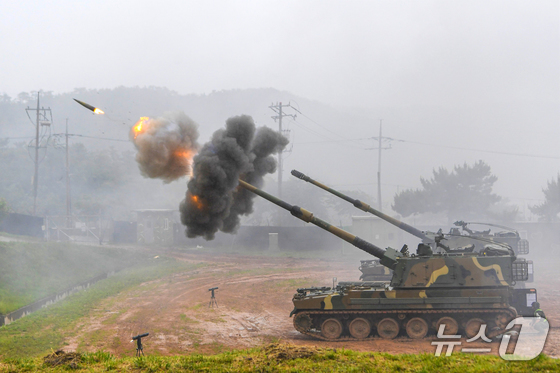
Given the land border between Russia, the greatest potential threat, and Europe, demand for ground defense systems such as tanks and howitzers is expected to rise. This could lead to increased export opportunities for systems like Hanwha Aerospace’s K9 self-propelled howitzers and Hyundai Rotem’s K2 tanks, which have been primarily exported to Poland.
A defense industry insider said that while Middle Eastern conflicts have driven demand for air defense systems due to terrain conditions, Europe’s geography is likely to increase demand for ground-based systems, adding that ammunition demand is also expected to rise as stockpiles are replenished.
Following the recent conflict, Hanwha Aerospace secured a role in Spain’s self-propelled howitzer modernization project through a partnership with the local firm Andra. Under the agreement, Hanwha will provide the K9 platform, while Andra will manufacture the chassis and related systems for delivery to the Spanish military.
However, higher barriers to entry remain a challenge. Under the European Defense Industrial Strategy, the EU plans to increase the share of domestically produced defense equipment from 20% to 60% by 2035. In response, companies such as Hanwha Aerospace and Hyundai Rotem are establishing local production facilities in Poland and Romania to maintain market access.
An industry representative said Europe’s defense sector may struggle to meet rising demand due to limited production capacity, adding that South Korean firms could find opportunities in the interim as Europe expands manufacturing capabilities.