

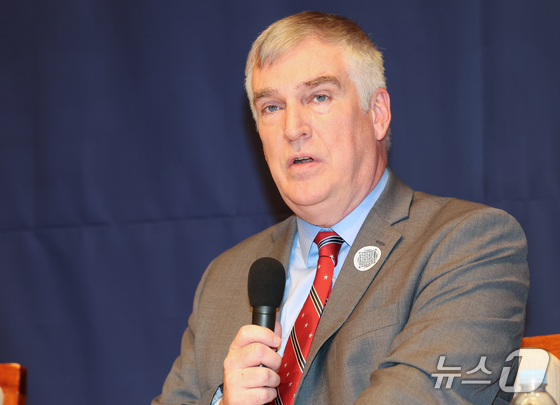
A senior fellow at the America First Policy Institute and close Trump ally outlined a broader vision for the U.S.-South Korea alliance on April 8, describing a strategic shift that expands the role of U.S. forces on the peninsula beyond North Korean deterrence to include countering China.
Speaking at the Asan Plenum 2026 in Seoul, Fred Fleitz — who served as executive secretary of the National Security Council during Trump’s first term — said the U.S. is pushing for greater strategic flexibility, which could include redeploying some troops across the Indo-Pacific for wider missions. He framed the shift as part of a broader realignment in which South Korea takes on more responsibility for its own conventional defense.
The Trump administration’s January defense policy directive formalized this approach, calling for South Korea to bolster its conventional capabilities against North Korea while freeing up U.S. forces to focus more broadly on the China challenge.
Fleitz praised South Korea’s commitment to the alliance, pointing to plans to raise defense spending to 3.5% of GDP, continued support for U.S. forces stationed on the peninsula, and purchases of advanced American weapons systems. He also highlighted growing cooperation in shipbuilding and defense technology as a driver of job creation and military interoperability between the two countries.
He pointed to deepening collaboration on nuclear-powered submarines and next-generation missile defense as signs of an evolving alliance structure — one where South Korea carries more of the defense burden while the U.S. maintains its security commitments.
On the alliance’s broader regional role, Fleitz advocated for South Korea’s inclusion in the Quad — the security grouping that includes the U.S., Japan, India, and Australia. He argued the country is a natural fit given its standing as the world’s 10th largest economy and its leadership in shipbuilding, artificial intelligence, and semiconductors.
Fleitz proposed joint patrols in the East and South China Seas, shared satellite intelligence for missile tracking, and a coordinated supply chain strategy for critical materials including semiconductors and rare earth elements. He was careful to frame these proposals as measures to strengthen regional stability rather than build an anti-China coalition.
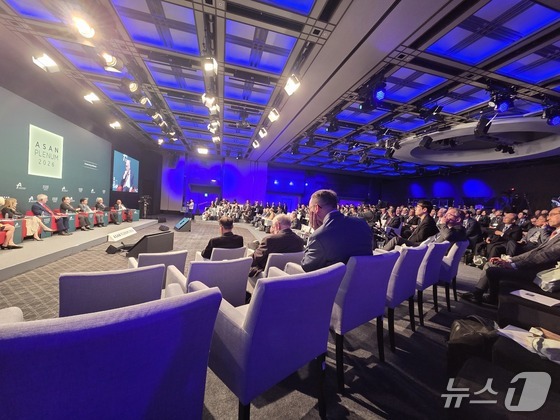
A former national security advisor and Korea University professor warned Tuesday that diverging views on alliance modernization between Washington and Seoul could create friction if left unaddressed.
Speaking at the Asan Plenum 2026, the former advisor explained that while the U.S. envisions expanding the alliance’s reach across the Indo-Pacific, South Korea remains focused on gradually upgrading its capabilities while keeping peninsular deterrence as its core mission. He attributed the gap to differences in geography, threat perception, and domestic political pressures on both sides.
“Forced alignment won’t work,” he said, cautioning against pushing either side into a posture it isn’t ready to adopt.
To close the gap, he proposed treating the Korean Peninsula and the Taiwan Strait as a single interconnected operational theater, given the overlapping security dynamics between the two. He also called for institutionalizing trilateral exercises and strategic discussions among the U.S., South Korea, and Japan, along with clearer crisis response roles and deeper cooperation in emerging domains including cyber, space, and intelligence, surveillance, and reconnaissance.
He stressed that modernizing the alliance should be a gradual process — not a binary choice between the status quo and a sweeping structural overhaul.
A former Japanese defense minister also weighed in, describing how the alliance has evolved from a purely military arrangement into a broader network designed to support peacetime deterrence and global stability. He noted that recent conflicts and military buildups around the world have increasingly blurred the line between military and non-military threats, as well as between peacetime and crisis conditions — making a wider alliance role more necessary than ever.
On the question of bilateral cooperation between Seoul and Tokyo, the former minister called for faster progress in cyber, space, energy, economic security, and defense technology. While civilian-level cooperation has advanced in recent years, he said military-to-military collaboration remains underdeveloped and needs to catch up.