


The Office of the United States Trade Representative (USTR) has publicly criticized South Korea’s discussions on network usage fees as an absurd trade barrier. However, experts in the domestic telecommunications industry argue that the U.S. claims do not reflect reality.
Domestic content providers (CPs) in South Korea bear network usage costs through contracts with telecom companies, while large global CPs like Google and Netflix don’t pay equivalent fees. This situation has led to claims of reverse discrimination against local companies.
The South Korean government maintains that there are currently no regulations mandating network usage fees in the country, nor any systems that discriminate against U.S. companies.
Some interpret USTR’s strong rhetoric, which has extended to social media platforms, as an attempt to influence legislative discussions in the National Assembly and exert additional pressure on the South Korean government regarding trade issues.
Trade Barriers? No Restrictions on YouTube or Netflix Operations
On Monday, USTR cited South Korea’s network usage fees as one of the 10 most absurd trade barriers faced by U.S. exporters. USTR claimed that no other country in the world imposes network usage fees on internet traffic sent to domestic internet service providers, making South Korea the sole exception.
The network usage fee debate centers on whether CPs generating significant traffic, such as YouTube and Netflix, should share the costs of using telecom networks.
However, the telecommunications industry views USTR’s characterization of trade barriers as excessive. They emphasize that YouTube and Netflix services are not blocked or restricted in South Korea, despite some global CPs not paying network usage fees.
A spokesperson for the telecom industry stated that the claim that network usage fees are a regulation unique to South Korea is false. Almost all CPs worldwide pay fees for transmitting network traffic. Both domestic and foreign CPs generally pay these fees, with only a minority not doing so.
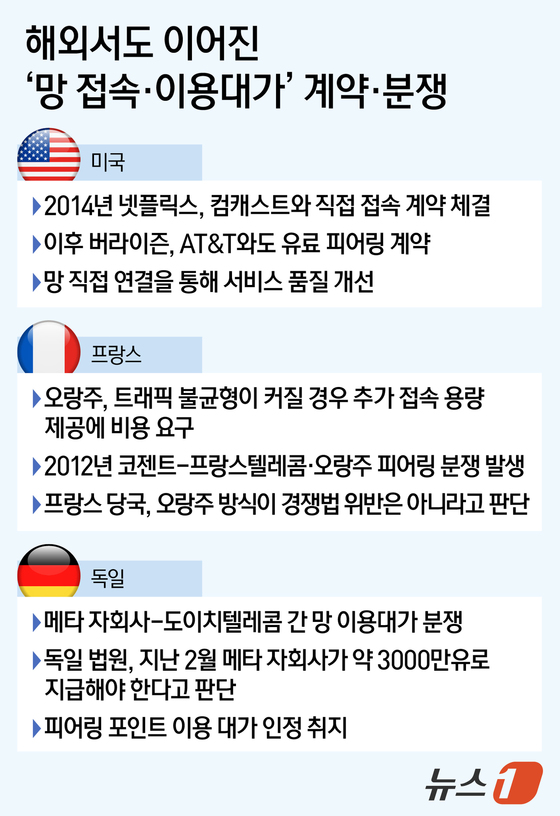
Controversy over claims of South Korean exceptionalism: Paid access cases abroad
Disputes and contracts regarding network access and transmission costs between major CPs and telecom companies have occurred internationally.
In the U.S., Netflix signed a direct interconnection agreement with Comcast in 2014, followed by paid peering agreements with Verizon Communications, Inc. and AT&T. These agreements allowed Netflix to improve service quality through direct connections with major U.S. internet service providers (ISPs).
In France, Orange demanded payment for additional access capacity when traffic imbalances became significant. French authorities did not view Orange’s charging for additional capacity in the 2012 peering dispute with Cogent and France Telecom/Orange as a violation of competition law.
In Germany, a dispute over network usage fees between Meta subsidiaries and Deutsche Telekom reached the courts. According to Reuters, a German court ruled in February that Meta subsidiaries must pay approximately 30 million EUR (about 35 million USD) for using Deutsche Telekom’s peering points.
The telecommunications industry cites these examples to argue that USTR’s claim that only South Korea discusses network usage fees is inaccurate. They contend that the real issue is not the discrimination claimed by the U.S. but rather the reverse discrimination faced by domestic companies.
A telecom industry representative explained that the discussion about institutionalizing network usage fees aims to regulate and normalize practices that avoid payment by leveraging negotiating power imbalances.
No Mandatory Regulations in Place: U.S. Pressure Seen as Attempt to Influence Legislation
The Ministry of Science and Information and Communications Technology (ICT) emphasizes that there are currently no separate regulations enforcing network usage fees in South Korea. They state that ISPs and CPs establish transaction conditions through voluntary contracts.
A Ministry official remarked that currently, network usage fees in South Korea are structured as voluntary contracts between telecom operators and content providers, and the outcomes should not be discriminatory. The government has consistently maintained a principle of not discriminating against any company, including U.S. firms, and will not implement or plan any systems that discriminate against companies from specific countries.
Analysts interpret USTR’s public criticism, which exaggerates even basic factual inaccuracies, as an attempt to curb legislative discussions regarding network usage fees in the National Assembly. USTR pointed out in the recently published 2026 National Trade Barrier Report (NTE report) that several bills have been introduced in the National Assembly since 2021 to require foreign CPs to pay network usage fees to South Korean ISPs.
A Ministry official stated that the U.S. appears to be more concerned about the potential passage of these bills rather than the current regulations.
USTR’s public criticism aligns with the Donald Trump administration’s trend of digital trade pressure. The joint fact sheet from the U.S. and South Korea last November also included assurances that U.S. companies would not face discrimination or unnecessary barriers in digital service-related laws and policies, including network usage fees and online platform regulations.
A representative from the telecom industry commented that USTR’s recent remarks seem to reflect the existing claims of U.S. companies, and there is not much difference in the argument itself from before.