Former Democratic Party leader Song Young-gil, currently visiting the U.S., reported on Thursday that U.S. congressional members indicated virtually no possibility of amending the Jones Act, which regulates coastal shipping. He stressed that for the Korea-U.S. shipbuilding industry cooperation project, Make American Shipbuilding Great Again (MASGA), to succeed, the U.S. needs to adopt a more forward-thinking approach.
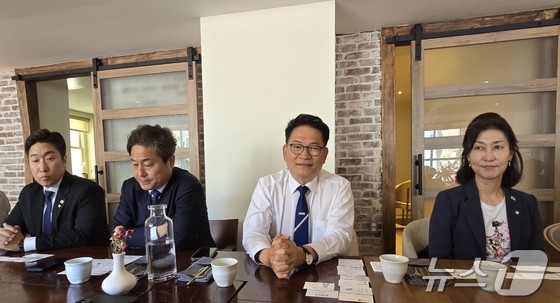
Song shared this information during a press briefing in Washington, D.C., alongside Democratic Party lawmakers Kim Young-bae and Kim Yong-man, and Justice Party lawmaker Kang Kyung-sook. He had met earlier that morning with Rep. Marilyn Strickland (D-WA), a member of the House Armed Services Committee.
When it inquired about the likelihood of modifying the Jones Act, they said it was almost non-existent, he reported.
Song cautioned that without amending the Jones Act, it won’t see any tangible results within President Donald Trump’s remaining three-year term. It’s explaining to the U.S. side that it will amount to nothing more than constructing factories.
He highlighted that the U.S. lacks Korea’s robust shipbuilding ecosystem and faces challenges in finding skilled workers. That’s why construction needs to happen in Korea with assembly in the U.S., he noted, underscoring the U.S.’s shortcomings in shipbuilding infrastructure and skilled labor.
Song also mentioned proposing to the State Department a plan for regional exceptions, similar to the Kaesong Industrial Complex rules under the Korea-U.S. Free Trade Agreement (FTA).
Additionally, Song discussed Hanwha Ocean’s Russia-bound icebreaking liquid natural gas (LNG) carriers with officials from the White House National Security Council (NSC), State Department, and Treasury Department.
It has nearly completed six icebreaking LNG carriers, a 2 trillion KRW (about 1.3 billion USD) order from Russia’s Novatek, but can’t deliver due to sanctions, he explained, adding that Russia has filed an 8 million USD claim against them with the International Chamber of Commerce.
He warned that losing this lawsuit without resolving the issue could plunge Hanwha into a liquidity crisis, leaving no funds for the MASGA project – ultimately harming U.S. interests too.
Song added that if Korean shipbuilding orders decline, they’ll shift to China. It’s trying to convince the U.S. why bolstering China’s industry is counterproductive.
During his visit, Song also raised concerns about double taxation for Korean companies investing in the U.S., including Hyundai Motor. He noted that beyond the Trump-era auto tariffs, steel and aluminum tariffs for capital investments pose a significant burden.
Regarding the Russia-Ukraine conflict, Song predicted that President Trump would attempt to mediate before the November midterms.
He shared that he tried to meet Vice President JD Vance, but scheduling conflicts prevented it. Instead, he discussed the Ukraine war with the NSC team, cautioning against repeating the previous administration’s mistake of pressuring Russia and China simultaneously, which inadvertently improved their relationship.
Song stated that if the Russia-Ukraine war concludes before the midterms and U.S.-Russia relations improve, it could lead to restored Korea-Russia ties and potential breakthroughs in Arctic shipping routes, icebreaker issues, and inter-Korean relations.
He also expressed plans to attend the Eastern Economic Forum in Vladivostok from September 1-3, led by President Putin. Song noted that post-war reconstruction projects in Russia may far exceed those in Ukraine. It should position to participate in rebuilding efforts for both nations.
Song mentioned discussing the transfer of wartime operational control (OPCON) with U.S. officials, though he didn’t provide specifics.
During his U.S. visit, Song met with Senator Andy Kim (NJ) and House Democratic Leader Hakeem Jeffries (NY) to discuss the Democratic Party’s midterm strategy and victory prospects. Song explained that he felt it crucial to meet Jeffries, as he’s the frontrunner for Speaker if Democrats win.
Lawmaker Kim Young-bae reported that U.S. think tank officials downplayed the likelihood of Korean Peninsula issues featuring prominently in talks during Chinese President Xi Jinping’s September U.S. visit.
Kim added that they expect U.S.-China discussions to focus primarily on trade. However, they acknowledged that any provocative actions by Kim Jong Un would necessitate a U.S. response.