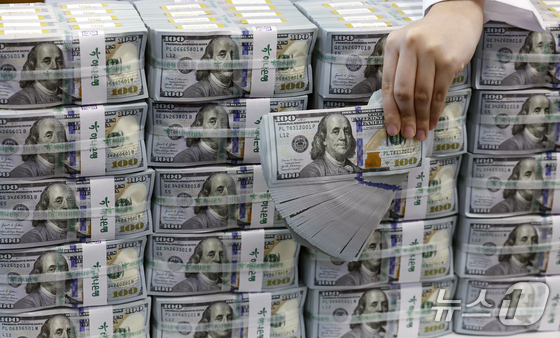
The U.S. Treasury Department has designated South Korea as a currency monitoring country for the fourth consecutive time in its latest exchange rate report. In response, the South Korean government has pledged to maintain close communication with the U.S. Treasury and continue efforts to stabilize the foreign exchange market.
On Friday, the Ministry of Economy and Finance reported that the U.S. Treasury released its Macroeconomic and Foreign Exchange Policies of Major Trading Partners report on Thursday, reaffirming South Korea’s status as one of ten countries on its monitoring list.
This report evaluates the macroeconomic and currency policies of the top 20 U.S. trading partners for the period from January to December of the previous year.
According to the ministry, South Korea retained its monitoring status by meeting two of the three criteria outlined in the Trade Facilitation Act: a significant trade surplus with the U.S. and a substantial current account surplus.
The trade surplus in goods and services with the U.S. reached 45 billion USD, far exceeding the 15 billion USD threshold, while the current account surplus hit 6.6% of gross domestic product (GDP), more than double the 3% benchmark.
However, South Korea fell short of the foreign exchange market intervention criterion, with net purchases amounting to only 1.5% of GDP, below the 2% threshold. This marks South Korea’s fourth consecutive appearance on the monitoring list since the second half of 2024 report.
The U.S. Treasury noted that South Korea’s export slowdown last year contributed to overall growth deceleration, while the current account surplus expanded significantly, particularly in high-tech sectors like semiconductors.
Despite a year-on-year decrease in the U.S. trade surplus, partly due to reduced auto imports, it remains more than double the level seen a decade ago.
The Treasury observed that despite these external surpluses, KRW has faced persistent downward pressure.
Reiterating its January assessment, the Treasury maintained that the recent weakness of KRW is inconsistent with South Korea’s strong economic fundamentals, emphasizing that excessive, one-sided depreciation of KRW is unwarranted.
The report specifically highlighted increased household and corporate investments in foreign stocks late last year as an additional factor exacerbating KRW’s depreciation.
On a positive note, the Treasury acknowledged South Korea’s progress in easing restrictions on foreign investor participation in the domestic forex market. These measures are expected to enhance market liquidity and price discovery mechanisms over the medium to long term.
The report also mentioned the National Pension Service’s dollar purchases for overseas investments last year, expressing interest in the fund’s new asset allocation framework and currency hedging strategies.
The Ministry of Economy and Finance affirmed its commitment to ongoing dialogue with the U.S. Treasury to foster mutual understanding and trust regarding foreign exchange markets, while continuing collaborative efforts to maintain market stability.