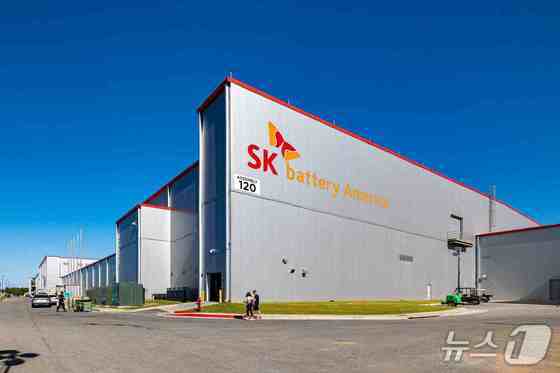
SK On is raising expectations for additional U.S. energy storage system (ESS) battery orders after securing a large-scale contract in the country. With U.S. ESS demand expanding and restrictions on China-linked supply chains tightening, SK On is expected to find new business opportunities thanks to its local production capacity and ability to respond to additional orders.
According to industry sources on the 1st, KB Securities said in a report published on August 31 that U.S. policies supporting ESS market expansion and supply-chain restructuring are likely to lead to increased orders for Korean battery companies.
KB Securities expects SK On’s ESS opportunities to expand further, given its order pipeline and production capacity. SK On recently signed a contract with U.S. company NeoVolta Power to supply a total of 9 GWh of lithium iron phosphate (LFP) pouch battery cells from 2027 through 2031. The industry estimates the contract to be worth approximately 1.5 trillion won. KB Securities described the deal as a large-scale order, considering that the U.S. ESS market is expected to reach around 100 GWh this year.
SK On is also discussing ESS supply contracts totaling more than 10 GWh with multiple U.S. customers, further raising expectations for additional orders.
The restructuring of the U.S. ESS supply chain is another factor supporting the outlook for new orders. According to KB Securities, Chinese companies currently account for about 80% of the U.S. ESS market. As U.S. restrictions on China-linked supply chains intensify, the current China-dominated market structure is expected to change.
On August 26, the U.S. government declared a national emergency over power-system security and moved to strengthen regulations on power equipment linked to certain foreign entities (CFEs) through Executive Order 14420. The regulated equipment includes battery energy storage systems (BESS), inverters, and transformers.
The measures could apply not only to newly installed equipment but also to existing CFE-related equipment, allowing authorities to order isolation, disconnection, replacement, or removal. Detailed implementation rules are expected to be announced by December 24.
Securities analysts expect the tougher regulations to create opportunities for Korea’s ESS industry. Samsung Securities said in a recent report that although no specific country was explicitly named as a target, the measure appears to be aimed at Chinese equipment in light of the Trump administration’s existing policy direction.
The U.S. is already reducing its dependence on China’s ESS supply chain through tariffs and tax-credit requirements. According to the Korea Institute for Industrial Economics and Trade, the combined tariff rate on Chinese ESS batteries this year is 40.9%, compared with 12.5% for Korean products, a gap of 28.4 percentage points. The Advanced Manufacturing Production Credit (AMPC) for companies producing batteries in the United States also remains in place.
With additional national-security measures potentially restricting transactions involving certain foreign-made BESS equipment, the range of regulatory tools targeting Chinese products has expanded.
Industry officials expect demand for alternatives to Chinese ESS products to increase as U.S. policy support and supply-chain restructuring progress simultaneously. SK On, with local production capacity and the ability to handle additional orders, could therefore see further ESS opportunities following its latest contract.