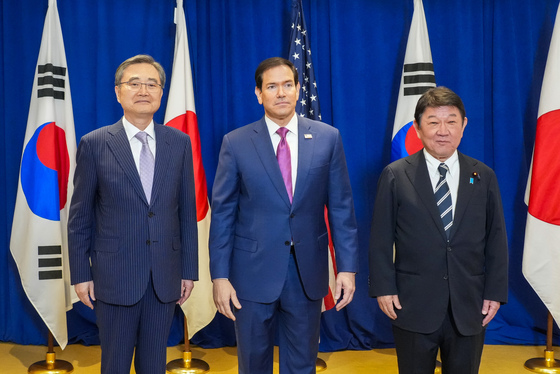
On Monday, the top diplomats of South Korea, the U.S., and Japan convened in New York City to reaffirm their shared commitment to North Korea’s complete denuclearization and urge the country to return to dialogue. Ahead of the upcoming U.S.-China summit, they also emphasized their cooperation on issues such as peace and stability in the Taiwan Strait and responses to economic coercion, sending a clear message of deterrence against China.
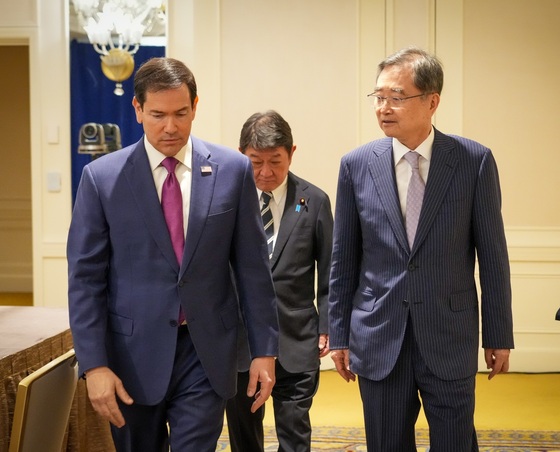
South Korean Foreign Minister Cho Hyun, U.S. Secretary of State Antony Blinken, and Japanese Foreign Minister Toshimitsu Motegi held a trilateral meeting on the sidelines of the United Nations (UN) General Assembly. They discussed Korean Peninsula issues, regional and global affairs, economic security, and practical cooperation measures, culminating in the adoption of a joint statement.
This meeting, occurring two months after similar discussions during the North Atlantic Treaty Organization (NATO) summit in July and Association of Southeast Asian Nations (ASEA) related ministerial meetings, marked the third such gathering this year.
The ministers reaffirmed their commitment to pursuing North Korea’s complete denuclearization and blocking funding for its nuclear and ballistic missile programs. They agreed to maintain a robust deterrence posture against North Korean threats while closely collaborating to ensure peace and stability on the Korean Peninsula and achieve denuclearization through dialogue and diplomacy.
They reiterated that the door to dialogue with North Korea remains open and urged the regime to return to negotiations. The ministers also emphasized the need for swift resolution of issues concerning abductees, detainees, unrepatriated prisoners of war, and separated families. Their joint agenda encompassed both North Korea’s nuclear issues and humanitarian concerns.
On the security front, the U.S. reaffirmed its ironclad defense commitments and extended deterrence pledges to South Korea and Japan, backed by its overwhelming military power, including nuclear capabilities.
Talks focus on the Taiwan Strait, economic coercion and supply chain issues, signaling clear coordination targeting China
With the U.S.-China summit scheduled for September 24, the meeting included significant content related to economic security with China in mind.
The three ministers stressed the importance of maintaining peace and stability in the Taiwan Strait and peacefully resolving cross-strait issues, opposing any unilateral attempts to change the status quo. They reiterated their support for Taiwan’s meaningful participation in appropriate international organizations.
China, which considers Taiwan part of its territory and regards cross-strait issues as a core interest, has been sensitive to external interventions.
The ministers also emphasized the need to ensure freedom of navigation and overflight globally, including in the Indo-Pacific, and to adhere to international law as reflected in the United Nations Convention on the Law of the Sea (UNCLOS). This statement likely addresses concerns about China’s extensive territorial claims in the South China Sea, which have caused friction with neighboring countries like the Philippines.
In the realm of economic security, they agreed to firmly oppose arbitrary export restrictions that disrupt supply chains, harmful overproduction, and economic coercion that distorts markets and involves non-market policies and practices, without directly naming China.
Furthermore, they welcomed efforts to diversify and strengthen key supply chains and the launch of a new trilateral consultative body on economic security. In advanced technology, they decided to jointly protect and develop artificial intelligence (AI), quantum technology, digital infrastructure, biotechnology, and the semiconductor industry while expanding cooperation among national research institutes.
In the energy sector, they commended South Korea’s efforts to enhance energy security through regional cooperation. They particularly welcomed the establishment of a concrete implementation plan for the effective and mutually beneficial execution of the memorandum of understanding on small modular reactor (SMR) cooperation signed on July 7. The three countries plan to intensify cooperation on deploying SMRs in third countries based on this agreement.
The ministers also exchanged views on geopolitical situations in Northeast Asia and the Middle East. They agreed to expand cooperation in areas where the three countries can make practical contributions, such as combating transnational crime, disaster relief, and humanitarian assistance.
Joint statement cites North Korea sanctions and Taiwan, while Foreign Ministry emphasizes dialogue and diplomacy
The U.S., South Korea, and Japan stated their firm commitment to North Korea’s complete denuclearization and to prevent financing for North Korea’s nuclear and ballistic missile programs. They welcomed the activities of the Multinational Sanctions Monitoring Team (MSMT) that tracks violations of United Nations Security Council resolutions and the international community’s joint alert regarding North Korean information technology (IT) workers.
In contrast, the South Korean foreign ministry’s press release stated that it will cooperate to maintain peace and stability on the Korean Peninsula and achieve denuclearization goals through dialogue and diplomacy while maintaining a firm deterrent posture against North Korean threats. While mentioning deterrence, they prioritized dialogue and diplomacy, and did not include specific details about implementing sanctions or blocking North Korea’s foreign currency earnings. This reflects the government’s approach to avoiding confrontation and conflict with North Korea.
The joint statement’s expressions regarding Taiwan and China included emphasizing the peace and stability of the Taiwan Strait, peaceful resolution of cross-strait issues, opposition to attempts to unilaterally change the status quo, and reaffirming the existing stance of the U.S., South Korea, and Japan in supporting Taiwan’s meaningful participation in appropriate international organizations.
Conversely, the South Korean foreign ministry only mentioned the importance of freedom of navigation and overflight worldwide, including in the Indo-Pacific, and adherence to international law as reflected in United Nations Convention on the Law of the Sea (UNCLOS), without directly referencing Taiwan. This can also be seen as reflecting the government’s diplomatic policy of improving relations with China.
Meanwhile, Reuters reported that U.S. allies, including South Korea and Japan, are concerned about the possibility that President Donald Trump may make concessions to China on Taiwan or trade issues during the U.S.-China summit.
The analysis suggests that President Lee Jae Myung and Japanese Prime Minister Sanae Takaichi are actively seeking opportunities to speak directly with President Biden during the UN General Assembly for this reason.
Trade issues also remain a major concern for South Korea and Japan. Reuters noted that even a slight reduction in U.S. trade barriers against China could significantly impact the export competitiveness of both countries, making them keenly aware of the summit’s outcomes.