

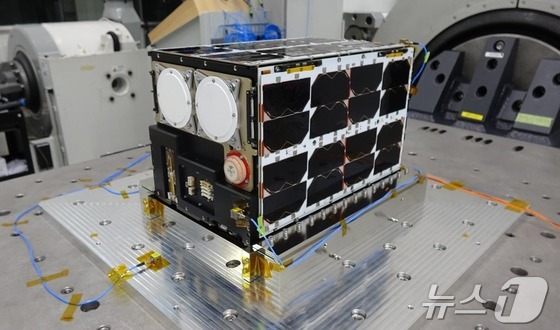
Samsung Electronics and SK Hynix, leading South Korean semiconductor companies, are set to validate cutting-edge semiconductor technologies in the National Aeronautics and Space Administration’s (NASA) Artemis mission, a crewed lunar exploration program. These technologies include radiation-resistant semiconductors that operate flawlessly even when exposed to high-energy cosmic radiation.
On Friday, the Korea Astronomy and Space Science Institute (KASI) announced that it had signed separate agreements with Samsung Electronics and SK Hynix on Wednesday to develop payloads for the CubeSat aboard Artemis 2.
The Korea Aerospace Administration (KASA) finalized a cooperation agreement with NASA on May 2, including KASI’s CubeSat, K-RadCube, on Artemis 2. This mission will be the first lunar flight crewed since the Apollo program.
KASI’s K-RadCube is designed to measure cosmic radiation, one of the most challenging aspects of space missions. It will be deployed before reaching the Moon and measure cosmic radiation in the Van Allen belts, regions of intense radiation above low Earth orbit.
To this end, KASI will collaborate with Samsung Electronics and SK Hynix on joint research, technology development, and shared equipment use for the K-RadCube payload.
KASI’s responsibilities include setting scientific objectives, establishing design requirements for the CubeSat, developing operational schedules, and coordinating international efforts for launch and communication plans.
Samsung Electronics and SK Hynix will design and produce the experimental module for the semiconductor device and develop operational scenarios for these experiments.
Samsung Electronics aims to verify if its next-generation semiconductors can function in the high-energy radiation environment of space at high altitudes. SK Hynix will provide radiation-resistant memory semiconductors suitable for various environments, including aerospace and terrestrial applications.
Nara Space will handle the satellite’s design, manufacturing, testing, and transportation to the launch site. KT SAT will establish the ground station infrastructure, including antennas and communication equipment, and manage satellite operations.
KASI President Park Jang Hyun emphasized that K-RadCube’s core technology addresses astronaut safety concerns regarding cosmic radiation exposure and bolsters Korea’s competitiveness in space technology.
The Artemis 2 mission, carrying K-RadCube, is slated for launch under NASA’s direction in April next year. Four astronauts will board Artemis 2, which will enter lunar orbit and perform a swing-by maneuver using the Moon’s gravity to return to Earth. South Korea is investing 10 billion KRW (approximately 7.1 million USD) in this mission