

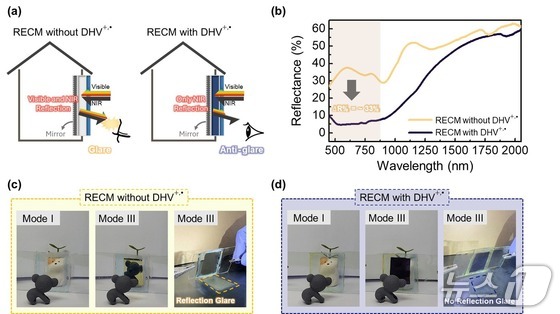
The Korea Advanced Institute of Science and Technology (KAIST) announced on Tuesday that its research team, led by Professor Moon Hong Cheol from the Department of Chemical and Biomolecular Engineering, has developed an innovative smart window technology called RECM. This cutting-edge technology can adjust incoming light and heat through windows according to user preferences while effectively reducing glare from external sources.
RECM, the next-generation technology developed by the team, is a smart window system based on a single-structure electrochromic device. It can actively control the transmission of both visible light and near-infrared heat.
The team has successfully addressed a longstanding issue with traditional metal-coated smart windows: glare caused by external reflections. By incorporating color-changing materials, they’ve created a pedestrian-friendly smart window suitable for building facades.
This advanced system operates in three distinct modes, controlled by voltage adjustments. It can function like regular glass, reflect both light and heat while blocking glare for pedestrians outside, or absorb light while allowing some heat transmission to regulate indoor temperatures and ensure privacy.
To validate the effectiveness of the RECM technology in reducing indoor temperatures, the research team conducted experiments using a miniature model house. When standard windows were used, the indoor temperature soared to 31.5°C (137.66°F) within just 45 minutes. In contrast, with RECM activated, the temperature only reached 31.5°C (88.7°F), demonstrating an impressive temperature reduction of about 27.2°C (48.96°F).
The system’s ability to transition between states using only electrical signals makes it a highly responsive smart technology that can quickly adapt to seasonal changes, the time of day, and specific user needs.
Professor Moon emphasized the significance of this research, stating that their work presents a truly comprehensive smart window platform that goes beyond existing technologies that only control visible light, addressing both active indoor heat management and pedestrian safety. He further expressed anticipation regarding wide-ranging applications, from urban buildings to vehicles and trains.
The groundbreaking results of this study were published in the prestigious international energy journal ACS Energy Letters.