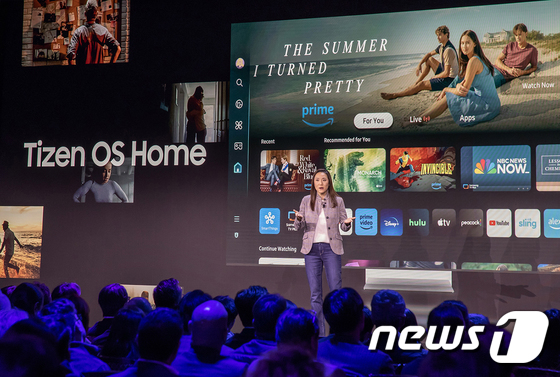
Samsung Electronics is expanding its smart television (TV) operating system (OS), Tizen OS, to major original design manufacturers (ODMs) in addition to other TV brand manufacturers. By significantly increasing the number of smart TVs running Tizen OS, Samsung Electronics aims to secure stable profitability through licensing and advertising revenue in the fiercely competitive TV market.
Industry sources reported on Wednesday that Samsung Electronics has recently broadened its Tizen OS licensing program to include prominent ODMs, coinciding with the launch of Tizen OS 8.0.
ODMs handle the design, development, and production of products for other companies. Previously, Samsung Electronics supplied Tizen OS only to TV brands that produced their products. A notable example is the luxury European TV brand Loewe, which began incorporating Tizen OS into its Stella TV line last July.
A substantial increase in global demand drives the expansion of the Tizen OS licensing program. The majority of TVs sold today are smart TVs, offering a wide range of internet-connected services. Success in this market requires not only superior hardware features, such as picture quality and design, but also robust software capabilities, including security, speed, intuitive user interfaces (UIs), and a rich content ecosystem.
Tizen OS offers features such as Samsung TV Plus, an ad-supported streaming service, and Gaming Hub, which allows users to enjoy cloud-based games without a separate console. It also integrates with the SmartThings platform, enabling convenient control of other appliances and Internet of Things (IoT) devices. Samsung’s Knox cybersecurity system protects user information from unauthorized apps and external hacking attempts.
These competitive advantages have enabled Samsung Electronics to maintain its position as the global TV market leader for 19 consecutive years, from 2006 to 2024, with over 270 million Samsung smart TVs now running Tizen OS.
The Connected TV Marketing Association (CTVMA) estimates that Tizen OS captured a 12.8% share of the global smart TV OS market last year, securing the top spot. Hisense’s VIDAA OS followed at 7.8%, with LG Electronics’ webOS at 7.4%. Other competitors included Roku TV and Amazon’s Fire TV (both at 6.4%), and Google Android TV at 5.9%.
Samsung Electronics is set to introduce Tizen OS to popular TV brands across various markets. Key partners include Australia’s EKO, Europe’s QBELL, Mexico’s RCA (Kayve Groupo), RCA (Treasure Creek) in the U.S. and Canada, and Germany’s Axdia. More brands are expected to adopt Tizen OS in the latter half of the year.
As Tizen OS becomes more widespread, Samsung Electronics is expected to benefit from both licensing revenue and increased advertising income generated through platforms such as Samsung TV Plus and Gaming Hub.
In an industry facing constant pressure from cost-cutting measures and marketing expenses, the revenue generated from the platform ecosystem offers a stable and effective solution for TV manufacturers.
Kim Ju-young, Executive Vice President of Samsung Electronics’ Visual Display Business, stated that Tizen OS has earned recognition for its performance, stability, and innovation. Further, this year, they’re focusing on expanding their licensing program and developing diverse collaboration strategies with their key partners.