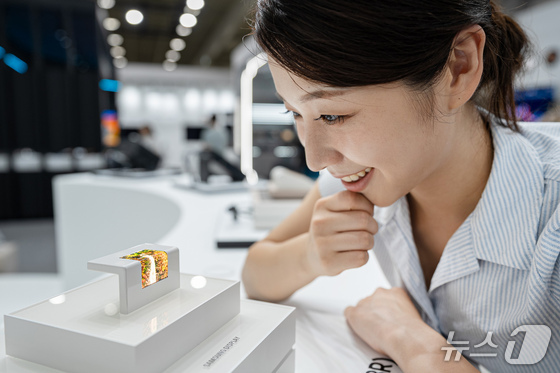
Samsung Display and LG Display, the two titans of the display industry, went head-to-head on Thursday, showcasing their cutting-edge organic light-emitting diode (OLED) technologies. Samsung Display unveiled its ultra-fine Organic Light-Emitting Diode on Silicon (OLEDoS) for mixed reality (XR) devices, boasting clarity up to ten times that of smartphones. LG Display, not to be outdone, presented OLED panels with world-leading resolution and refresh rates.
Samsung Display Unveils Ultra-Fine OLEDoS for XR Devices, 6000-Nit Micro LED
At the K-Display 2025 exhibition, held from Thusrday to Saturday at COEX Convention & Exhibition Center in Seoul’s Gangnam district, Samsung Display set up a booth themed Exploring Future Lifestyles with OLED Innovation. The company showcased a range of next-generation OLED technologies.
The spotlight was on Samsung Display’s ultra-fine OLEDoS, featuring a binocular demo product with a 1.3-inch, 10,000-nit (4,000 PPI) white OLEDoS display. OLEDoS technology, a key component in XR headsets, creates ultra-high-definition displays by depositing organic materials on silicon wafers, achieving pixel sizes as small as tens of micrometers.
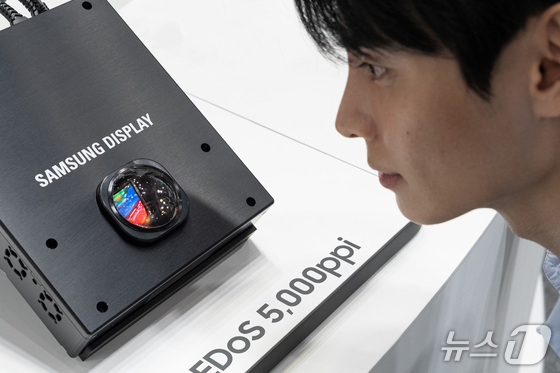
To put this in perspective, the latest smartphones typically offer around 500 PPI. Samsung’s OLEDoS technology delivers image quality 8-10 times sharper. The company also exhibited its highest-resolution red, green, and blue (RGB) OLEDoS to date: a 1.4-inch display with 5,000 PPI, packing three times the pixels of a 4K television (TV) into a watch-sized screen. Additionally, they showcased a 1.3-inch RGB OLEDoS capable of 20,000 nits brightness at 4,200 PPI.
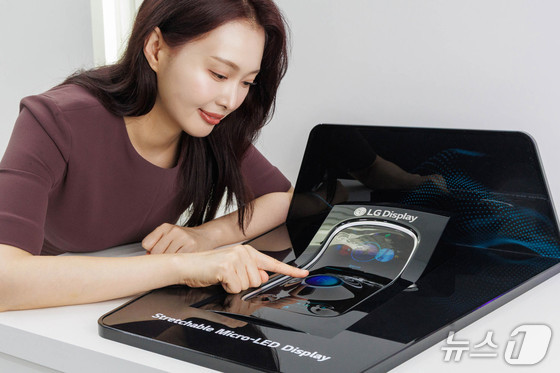
In a significant leap forward, Samsung Display debuted a 6,000-nit micro light-emitting diode (LED) for next-gen smartwatches. This marks a 2,000-nit increase from the 4,000-nit product unveiled at Consumer Electronics Show (CES) 2025 just six months ago. The display boasts a 326 PPI resolution, featuring 700,000 RGB LED chips, each a mere 30 µm in size. It offers unparalleled flexibility with consistent color and brightness from any viewing angle. The exhibition also featured a gaming room equipped with OLED monitors. Visitors could explore a variety of products, including the industry’s first 500 Hz self-emissive 27-inch quad high definition (QHD) monitor, a 27-inch ultra high definition (UHD) monitor with best-in-class pixel density, and wide-format monitors ideal for multitasking.
Samsung Electronics introduced MONTFLEX™, its new brand for market-leading foldable OLEDs, along with LEAD™, the brand name for its groundbreaking polarizer-free on-cell-film (OCF) technology.
Art enthusiasts could enjoy the OLED Gallery, which showcased works by renowned contemporary artists such as Basim Magdy and Marc Dennis on OLED screens. An interactive zone allowed visitors to take high-resolution selfies using quantum dot (QD) OLED technology and create artificial intelligence (AI)-generated images.
LG Display Showcases 4th Generation OLED and World’s Fastest Monitor
LG Display organized its booth around the theme Shaping the Future, presenting innovative display technologies across various applications—from large-scale TVs to smartphones and automotive displays. The company’s experience zone provided hands-on demonstrations of world-first and industry-leading display technologies.
Visitors to LG Display’s booth could trace the 16-year evolution of OLED technology, from early 15-inch TV prototypes (2009) to the latest advancements. The timeline featured tandem OLED structures, deuterium-based 2nd generation panels, 3rd generation micro-lens array technology, and the primary RGB tandem structure of 4th generation OLED panels.
At the entrance, the booth showcased an 83-inch OLED panel featuring LG’s latest 4th generation OLED technology. This breakthrough achieves up to 4,000 nits brightness using an industry-first primary RGB tandem structure that stacks red, green, and blue layers independently.
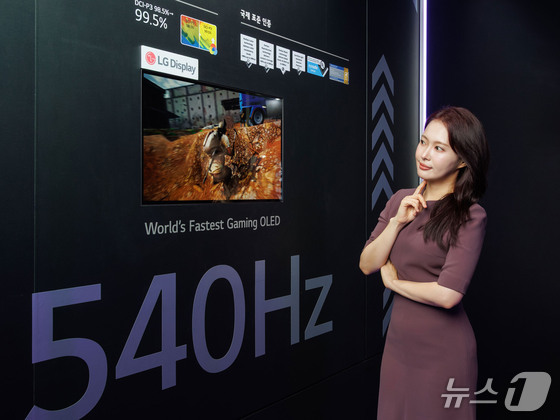
LG Display unveiled the world’s fastest OLED monitor panel—a 27-inch QHD display capable of a 540 Hz refresh rate. Using Dynamic Frequency & Resolution (DFR) technology, it can reach up to 720 Hz in high definition (HD) mode. Combined with 4th generation OLED technology, it offers a 99.5% Digital Cinema Initiatives Protocol 3 (DCI-P3) color gamut and 1,500 nits peak brightness, setting a new standard for OLED monitor quality.
The company’s automotive display technologies were demonstrated in a concept car designed for fully autonomous driving. The centerpiece was a massive 57-inch pillar-to-pillar liquid crystal display (LCD), the largest vehicle display available, featuring a curved screen for seamless delivery of information and entertainment.
LG Display also presented a 14-inch tandem Advanced Thin OLED (ATO) display, which utilizes a tandem structure for high brightness and low power consumption, as well as a 14.5-inch LCD designed to maximize battery life through advanced oxide thin film transistor (TFT) and low-power backlight technologies.