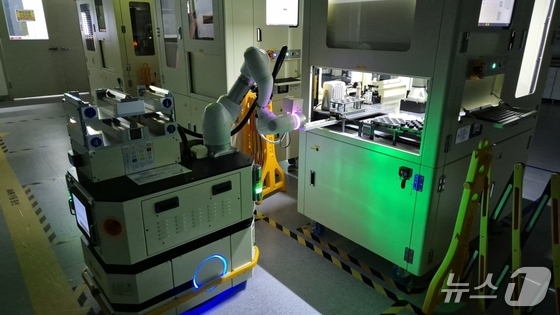
LG Chem announced on Monday that it has established the first Autonomous Smart Lab in the South Korean chemical industry at the Analytical Research Center of its Daejeon Technology Research Institute.
The Analytical Research Center plays a key role in enhancing next-generation battery material competitiveness by precisely analyzing essential components of electric vehicle batteries, such as lithium, nickel, cobalt, and manganese. With the implementation of this robotic automation lab, the company can now automate hazardous and repetitive analytical processes, promising improvements in both safety and efficiency.
Notably, once a staff member places a sample in the storage, the robot can manage the entire sequence—from sample retrieval to pre-treatment, analysis, and disposal. The system automatically inputs analysis data, enabling rapid responses to customer inquiries.
Previously, researchers had to personally handle experiment preparation and execution during working hours. However, the new robotic automation lab creates an unrestricted research environment that allows experiments to run 24/7, 365 days a year. This change enables researchers to concentrate on high-value tasks, such as developing new analytical methods.
Building on this initiative, LG Chem plans to establish additional automated analysis labs at its Magok Research and Development (R&D) Campus. In the long term, the company aims to create artificial intelligence (AI) transformation (AX) convergence automation labs that incorporate AI-based analysis data interpretation, further elevating research efficiency and safety standards.
LG Chem’s Chief Technology Officer (CTO), Lee Jongku, stated that automating analysis is not merely about improving the efficiency of routine tasks; it’s about creating an environment where researchers can immerse themselves in creative and strategic R&D. Noting that through this, it will lead the way in next-generation materials competitiveness and respond proactively to market changes.