

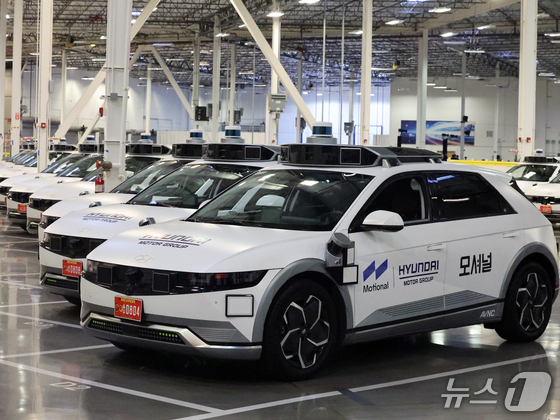
From Data Checks to Calibration, Charging, and Control Center Monitoring, All of Motional’s Operational Systems are Seamlessly Integrated
A short drive of about 10 minutes from the southern end of the Las Vegas Strip, the glittering billboards and tourist crowds gradually give way to the runways of Harry Reid International Airport. At the end of 730 Pilot Road stands the Las Vegas Technical Center, Hyundai Motor Group’s cutting-edge research facility for its autonomous driving joint venture, Motional.
On January 8, Hyundai Motor and Kia offered South Korean media their first glimpse of the Las Vegas Technical Center. This facility is the crucible where Motional’s advanced autonomous driving technology is being perfected, with plans to launch a fully driverless robo-taxi service in Las Vegas by year’s end.
Motional operates three key locations in the U.S. While the Boston headquarters oversees overall autonomous driving technology development, the Pittsburgh facility specializes in machine learning, hardware engineering, and vehicle modifications. The Las Vegas Technical Center serves as a critical proving ground for commercialization, integrating operations, maintenance, and control functions.
Las Vegas was selected as the ideal testbed for autonomous driving technology due to its complex urban landscape. The city’s constant stream of global conventions and performances, high-traffic hotel and casino drop-off points, and the intricate dance of tourists and vehicles create a challenging environment. Add to this the frequent road construction and closures, and you have the perfect gauntlet for pushing autonomous systems to their limits. Nevada’s business-friendly regulations and year-round stable weather further enhance the city’s appeal for ongoing testing.
Spanning roughly 11,240 square meters (about 120,986 square feet) , the center houses research and development (R&D) facilities, maintenance areas, a control center, and charging stations. A substantial closed-course test track lies nearby. As the launch site for Motional’s inaugural robo-taxi service, the center boasts a spacious garage and a state-of-the-art control center that monitors robo-taxi operations across Motional’s global network.
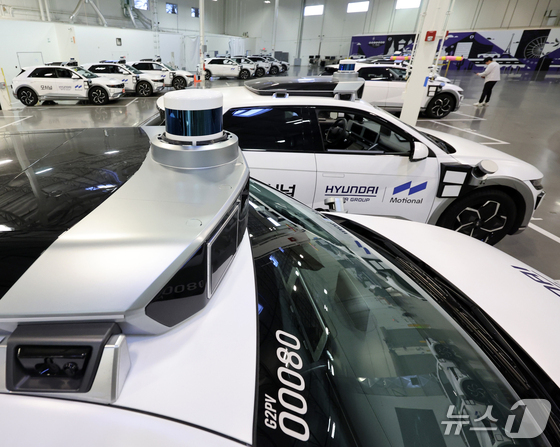
Beyond the security checkpoint, a vast 3,300-square-meter (about 35,520 square feet) perational garage unfolds – the nerve center of robo-taxi operations. Rows of Ioniq 5 robo-taxis stand at attention in precisely marked spaces. Each vehicle bears a unique identifier, ensuring its return to the exact spot after urban excursions, facilitating comprehensive fleet management of maintenance records and vehicle status. Engineers diligently inspect returning vehicles, connecting laptops and diagnostic tools to scrutinize sensor conditions and software logs.
Dave Schwenk, Vice President (VP) of Software, explains that the autonomous vehicles generate terabytes of driving data daily. Even the slightest data anomaly can significantly impact driving decisions, so we prioritize data integrity checks over mechanical inspections during maintenance.
This system goes beyond monitoring individual vehicles. It orchestrates the driving history, battery status, sensor condition, and software versions across the entire fleet, creating a unified management ecosystem.
The garage features an innovative charging system that can power two vehicles simultaneously from a single unit, maximizing both space efficiency and utilization. During charging, vehicles upload their driving data to central servers, with over-the-air software updates occurring concurrently when necessary.
A dedicated calibration room occupies one corner of the garage, where technicians meticulously adjust and verify the accuracy of autonomous vehicle sensors – cameras, LiDAR, and radar. Balaji Kannan, VP of Autonomous Driving, emphasizes that in urban environments, even minor perception errors can lead to drastically different decisions. Regular calibration is non-negotiable for ensuring safe autonomous driving. Only vehicles that pass this rigorous process are cleared for urban deployment.
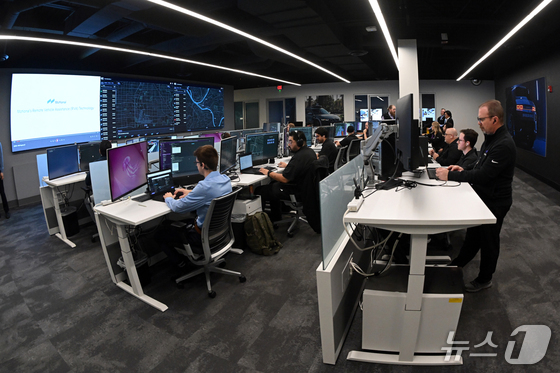
Transitioning from the calibration room to the control center reveals an impressive 20-meter (about 66 feet) video wall. Real-time maps of Las Vegas and Pittsburgh display a wealth of information – vehicle locations, movement trajectories, operational statuses, and live event data – all at a glance.
The control center staff don’t directly operate individual vehicles; instead, they monitor situations and provide decision support when needed. Vehicles maintain primary control over their operations but can request assistance from the control center in exceptional circumstances, such as attempted manual override of steering or the approach of emergency vehicles.
A comprehensive tour of the facility underscores that autonomous driving has evolved beyond a mere assemblage of technologies. From data checks and maintenance in the garage to calibration, charging, and control center monitoring, every element is woven into a cohesive operational tapestry.
Motional emphasizes that this advanced infrastructure, coupled with its partnership with Hyundai Motor Group, is the key to safe autonomous driving. Laura Major, Motional’s President and Chief Executive Officer (CEO), asserts that by combining Hyundai Motor Group’s prowess in high-quality, efficient vehicle manufacturing with Motional’s artificial intelligence (AI) technology and autonomous fleet management expertise, it is realizing the mission. It stands ready to revolutionize mobility and set new benchmarks for road safety.