


1X Technologies, a Norwegian-American humanoid robot startup backed by OpenAI, revealed the launch timeline for its home-use humanoid NEO at the Consumer Electronics Show (CES) 2026. This move signals a significant push into the artificial intelligence (AI) early adopter market.
NEO has been available for pre-order since last October, with a one-time purchase price of 20,000 USD or a monthly subscription of 499 USD. 1X Technologies plans to begin deliveries in the U.S. this year, expanding to Europe and Asia next year.
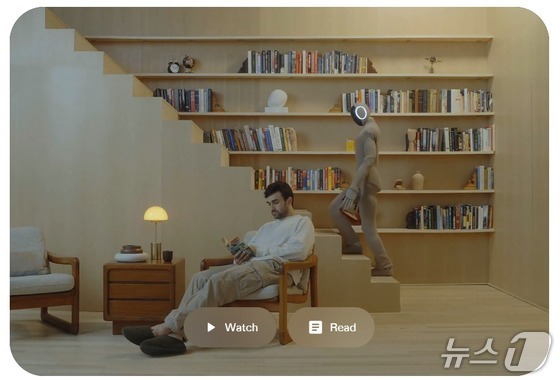
Industry sources reported on Wednesday that NEO’s core strategy involves applying Tesla’s fleet learning approach, used in Full Self-Driving (FSD) development, to robotics. The initial model incorporates a Hybrid AI system.
NEO is equipped with a Physical AI brain. While initially relying on remote control, it’s designed to evolve towards fully autonomous behavior through over-the-air (OTA) software updates based on accumulated data.
Currently, NEO can perform basic actions like walking, balancing, and grasping. However, it lacks sufficient training data for more complex tasks such as folding laundry or cooking.
To address this, 1X Technologies is implementing a 1X Expert Teleoperation learning mode. Specialized remote operators wearing virtual reality (VR) headsets will guide NEO, helping it gather and refine data.
On Monday, 1X announced an update to their 1X World Model, which translates predictions into physical actions using an inverse dynamics model.
Bernt Børnich, Chief Executive Officer (CEO) of 1X Technologies, stated that NEO can now learn from videos and directly apply that knowledge to the physical world, indicating that NEO has begun to learn independently.
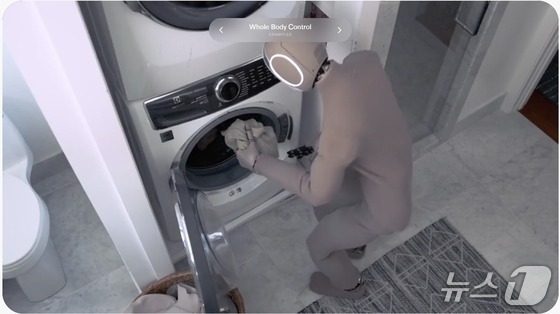
However, the American tech community, particularly on platforms like Reddit, has raised concerns. Critics argue that paying 499 monthly USD (or 20,000 USD upfront) essentially means compromising personal privacy.
A major worry is that the robot’s dual cameras could expose the entire interior of a home to external operators in real-time.
1X Technologies has responded by outlining security measures, including operator identity verification, automatic face blurring, restricted access zones, and user-controlled local data storage and deletion.
A 1X Technologies spokesperson explained that NEO communicates with users in real-time via light-emitting diode (LED) rings on its ears. They added that all remote operators are 1X Technologies employees, with one supervisor overseeing every eight operators.

Research communities and legal experts have emphasized that the data 1X Technologies aims to collect is highly personal and sensitive, requiring top-tier security measures.
UC Berkeley Professor Ken Goldberg highlighted fundamental challenges facing humanoid robots in a paper published in Science Robotics.
Goldberg noted that humanoid AI isn’t progressing as rapidly as language models because physical interaction data for robots is far scarcer than text or image data. Bridging this gap through teleoperation will be a lengthy process.
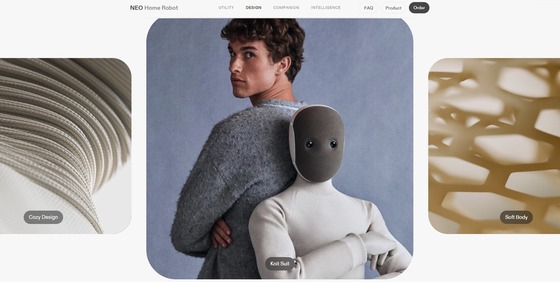
NEO stands at 168 cm (about 5.5 ft) tall, weighs 30 kg (about 66 lbs), and can lift up to 70 kg (about 154 lbs). It operates for four hours on an 842Wh battery and features the 1X NEO Cortex based on Nvidia’s Jetson Thor chipset platform.
1X is Technologies also targeting the industrial humanoid robot market. Last December, it inked a deal with Swedish private equity firm EQT AB to supply up to 10,000 units to over 300 portfolio companies by 2030.
To date, 1X Technologies has secured over 130 million USD in funding from investors including the OpenAI Startup Fund, Tiger Global, and EQT Ventures. The company is now seeking an additional 1 billion USD in investments this year.