

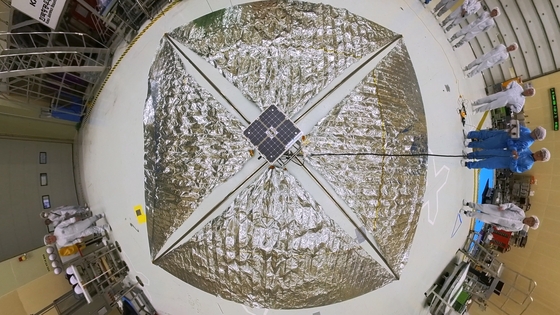
On February 13, the Korea Aerospace Research Institute (KARI) announced the successful development and ground demonstration of an orbital deorbiting device designed to capture and remove the rapidly increasing space debris in low Earth orbit.
Traditional space debris removal methods involved cleaning satellites directly approaching and capturing debris before guiding it to re-enter the atmosphere. This approach was limited by the use of expensive satellites for one-time missions.
To overcome this limitation, KARI researchers applied a concept that separates the deorbiting device from the cleaning satellite responsible for its transport and deployment.
By equipping a single cleaning satellite with multiple deorbiting devices, each can be used for separate debris removal missions, significantly enhancing the satellite’s reusability and cost-effectiveness.
The deorbiting device developed by KARI features a towing mechanism that attaches a tow plate to space debris and pulls it in, along with a capture function that securely grips the debris once approached.
Remarkably, despite being only the size of a rice cooker, the deorbiting device can deploy a solar sail covering approximately 269 square feet (about 25 square meters) when expanded. This allows it to collect space debris and guide it into the atmosphere using only sunlight and interactions with the sparse atmosphere in low Earth orbit, eliminating the need for additional propellants.
KARI expects this technology to have applications beyond space debris removal, including rendezvous and docking technology and deep-space solar sail propulsion systems.
KARI President Lee Sang-cheol stated that it will continue our research to ensure that this solar sail-based deorbiting technology can be applied to sustainable space environment management and various space activities. It remains committed to developing future technologies for addressing challenges in the space environment.