

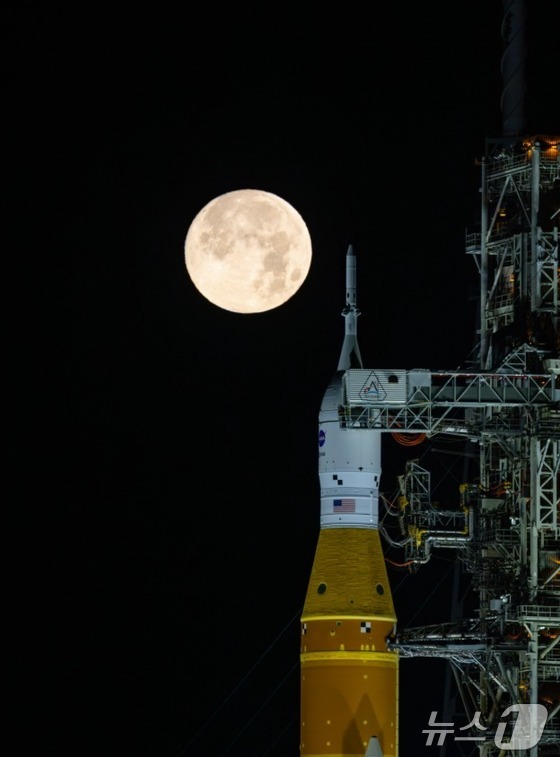
The National Aeronautics and Space Administration (NASA) has initiated its second Wet Dress Rehearsal (WDR) countdown, preparing for the first crewed lunar orbit flight in 54 years.
According to industry reports on Thursday, NASA began the Artemis II WDR countdown at Launch Pad 39B of Florida’s Kennedy Space Center on January 17 at 6:50 p.m. Eastern Standard Time (EST).
The simulated launch is scheduled for approximately 49 hours and 40 minutes later, on Thursday at 8:30 p.m. EST. This test is expected to continue until around 12:30 a.m. on Friday.
This rehearsal serves as the final full-scale practice before the actual launch day. It involves fueling the massive Space Launch System (SLS) rocket as in a real launch scenario and conducting a countdown to the moment just before liftoff. After the test, the team will also verify the fuel draining process.
Notably, the team will repeat the most critical 10-minute pre-launch segment twice. They will pause at T-minus 1 minute and 30 seconds, then again at T-minus 33 seconds. Subsequently, they will reset the clock to T-minus 10 minutes and repeat the same procedures. This drill prepares the team for potential launch delays due to mechanical issues or adverse weather conditions.
The first final check on February 2 was halted due to a liquid hydrogen leak caused by a malfunction in the ground support equipment connected to the rocket’s core stage.
Following this incident, NASA replaced filters on the relevant equipment and conducted thorough inspections before proceeding with the second final check. After the rehearsal, the team will analyze all data to determine the actual launch date, with March 6 currently being considered the earliest possible launch date.
Artemis II aims to send humans into lunar orbit for the first time since Apollo 17 in 1972. Four astronauts will embark on a mission to orbit the Moon for about 10 days, testing a swing-by maneuver that utilizes lunar gravity. The subsequent third phase of the mission aims to land humans on the Moon.
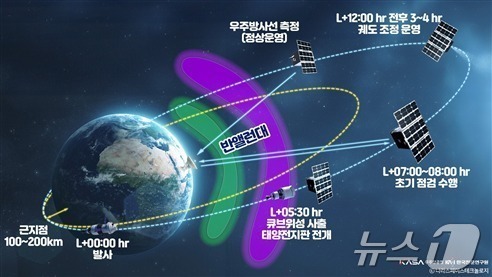
The mission will also carry the K-RadCube, a small satellite developed by the Korea Astronomy and Space Science Institute. K-RadCube will be deployed from the launch vehicle’s upper stage at an altitude of approximately 70,000 km (about 43,495 miles) before entering its own orbit.
The satellite will attempt its first communication within about two hours and conduct scientific observations for approximately 28 hours in its normal orbit. If the satellite and its payload remain stable, the mission could be extended for an additional two weeks.
K-RadCube’s primary mission is to precisely measure cosmic radiation intensity at various altitudes while passing through Earth’s Van Allen radiation belts.
The Van Allen belts are regions of intense radiation particles that any crewed spacecraft heading to the Moon must traverse. Radiation exposure is considered one of the most significant risks in long-duration deep space exploration.
The data collected from this observation is expected to provide crucial information for designing radiation shielding and developing operational strategies for future crewed lunar landings and deep space exploration missions.