

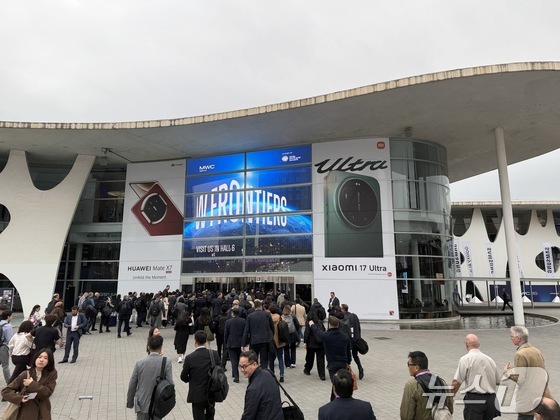
Chinese tech companies are leveraging the Mobile World Congress (MWC26) as a global stage to showcase their technological prowess. This year’s event attracted around 350 Chinese firms, making it one of the largest contingents after Spain and the U.S. Chinese companies demonstrated their capabilities across various sectors, including smartphones, robotics, network equipment, and artificial intelligence (AI) infrastructure, unveiling cutting-edge technologies.
Upon entering the main exhibition hall on Thursday, the strong presence of Chinese companies is immediately apparent. Massive advertisements for Huawei’s Mate X7 smartphone and Xiaomi’s Xiaomi 17 Ultra adorn the exterior walls, greeting visitors as they arrive.
However, some industry observers note that the event’s prominence has been waning as Samsung Electronics and Apple now announce their new products independently of MWC. The focus of the global information technology (IT) market has rapidly shifted from mobile internet to AI and robotics, resulting in greater interest in the Consumer Electronics Show (CES) held in the U.S., while MWC has seen a relative decline in attention.
With Samsung Electronics and Apple’s reduced presence, Chinese companies have stepped in to fill the void, their influence palpable throughout the exhibition hall. Huawei’s expansive display dominates a significant portion of Hall 1, strategically positioned to capture visitors’ attention as they enter the venue.
Among the highlights is Huawei’s Atlas 950 SuperFord, a data center powerhouse designed for large-scale AI computations. This AI computing platform integrates 8,192 of Huawei’s latest Ascend 950 DT AI chips into a single cluster, enabling simultaneous learning and inference in a rack-scale system.
At the heart of this system lies Huawei’s proprietary interconnect solution, UnifiedBus. This architecture maximizes data transfer speeds between chips and is viewed as a direct competitor to Nvidia’s NVLink technology.
Huawei claims the system can achieve computing performance of approximately 8 exaflops (EF) and a bandwidth of 16.3 petabytes (PB) per second. According to their announcement, this performance surpasses Nvidia’s next-generation AI accelerator platform, Vera Rubin, by about 6.7 times.
Growing Iinfluence Amid Technological Challenges
Honor, a Chinese smartphone manufacturer, unveiled a concept device that merges smartphone and robotics technology. Dubbed the robot phone, it features a small gimbal-style camera module that extends from the top of the smartphone.
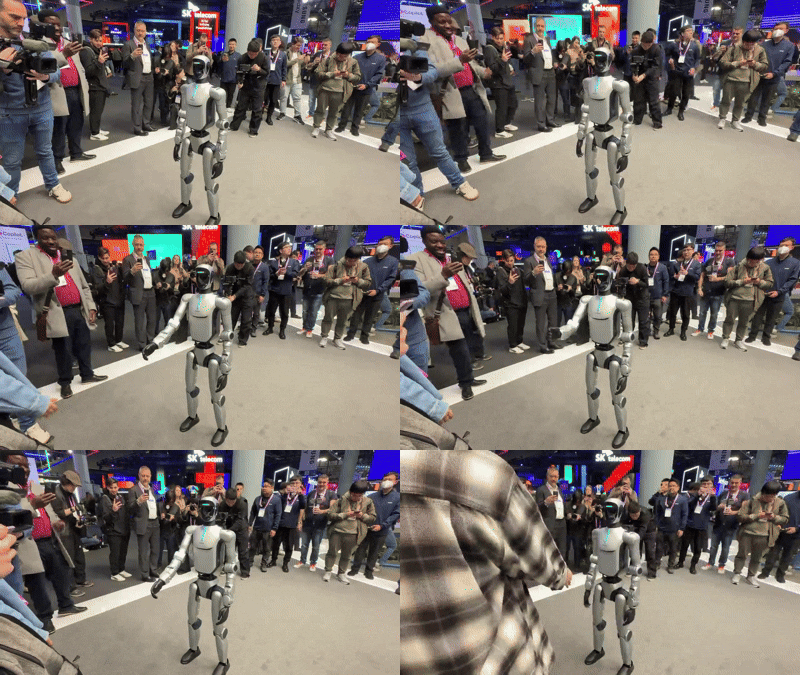
While the camera is designed to automatically track subjects during filming, demonstrations revealed instances where it lost focus and captured unintended scenes. Similarly, a humanoid robot attempted to shake hands with visitors, but its movements appeared stilted and unnatural.
Xiaomi’s exhibit emphasized its expansion beyond smartphones into mobility and AI ecosystems. The centerpiece of their display was the SU7 electric vehicle (EV), which drew significant attention from attendees. They also showcased personal mobility products like electric scooters, highlighting their strategy to integrate smartphones, smart homes, and electric vehicles into a unified platform.
The company also demonstrated AI image generation capabilities on their Xiaomi Pad 8 Pro tablet using a stylus. Users could create simple sketches, which the AI would then use as a basis to generate new images.
However, the live demonstration revealed limitations in the technology. Rather than refining the user’s original sketch, the AI often generated entirely new images. The process of selecting styles and choosing final images involved multiple steps, making it feel more like a proof of concept than an intuitive creative tool.
Throughout the MWC exhibition, Chinese companies showcased a wide array of technologies, from AI infrastructure to mobility solutions and robotic devices, underscoring their growing influence in the tech world. While some technologies appeared to be works in progress, the increasing prominence of Chinese tech firms on the global stage was undeniable.