

A research team in Asia has developed a core technology to overcome the “catastrophic forgetting” problem in multimodal artificial intelligence (AI), drawing attention on the global stage.
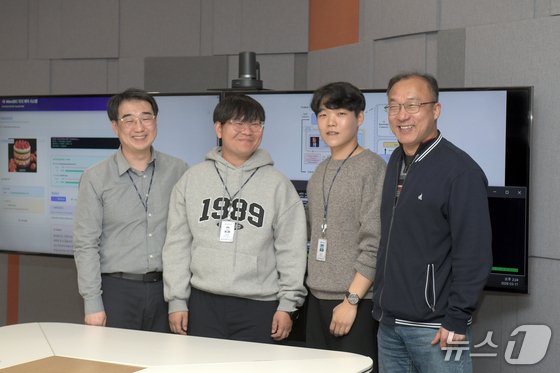
The Electronics and Telecommunications Research Institute (ETRI) Language Intelligence Research Laboratory, led by Director Lim Soo-jong, in collaboration with Pohang University of Science and Technology and Sungkyunkwan University, developed the “Memory-based Editable and Integrated Composite Knowledge (MemEIC)” technology and presented it at the 2025 Neural Information Processing Systems (NeurIPS) conference, the institute said on the 24th.
Multimodal AI can understand images and text simultaneously, but it has faced limitations in accurately answering complex queries due to “catastrophic forgetting,” in which previously learned knowledge is lost when new information is acquired, as well as confusion between visual and language knowledge. For example, when visual and textual information related to “Dubai chewy cookies” are learned separately and then queried, conventional AI systems can produce incorrect or irrelevant answers.
Instead of directly modifying core internal parameters of AI models, the ETRI team introduced a structure that stores new information in an external auxiliary memory system, separating storage and selectively integrating it when needed. Similar to the left and right hemispheres of the brain, visual information is stored independently in a “visual adapter,” while language information is stored in a “language adapter,” and a “knowledge connector” links the two based on context to improve answer accuracy for complex queries.
AI systems applying MemEIC recorded nearly 70% accuracy on complex queries across 1,278 Composite and Complex Knowledge Editing Benchmark (CCKEB) tasks, more than doubling the 36% to 52% range of existing systems. The technology also demonstrated “locality,” meaning newly added knowledge does not affect responses to previously learned queries.
Lim Soo-jong said, “This technology achieves both the integration of up-to-date information and reliability, and we plan to further advance it to ensure stable application of industrial data.” The research was supported by the Ministry of Science and ICT and the Institute for Information and Communications Technology Planning and Evaluation.