On Tuesday, the Korea Research Institute of Chemical Technology announced a breakthrough by Dr. Kang Young-hoon’s research team. They successfully manufactured environmentally friendly, high-performance thermoelectric materials based on silver selenide (Ag₂Se) under lower temperature and pressure conditions than previously possible.
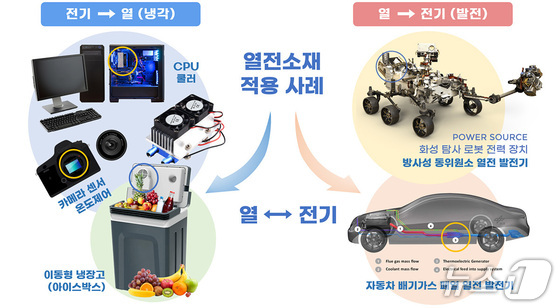
Thermoelectric materials, capable of converting heat into electricity and vice versa, are gaining traction in various energy applications. These include cooling electronic devices and harnessing waste heat for power generation. The materials operate on two principles: the Peltier effect, which uses electricity to cool and heat both sides of the material, and the Seebeck effect, which generates electricity from temperature differences.
Products utilizing the Peltier effect, such as coolers for computer components and compact camping refrigerators, are widely available in the market.
The Seebeck effect is being explored and applied in next-generation energy production technologies, including thermoelectric generators for space exploration equipment and systems that convert waste heat from factory and vehicle exhaust into usable energy.
Currently, the most common commercial thermoelectric materials are based on bismuth telluride (Bi2Te3). However, these materials have drawbacks, including price volatility of rare elements like tellurium and environmental concerns due to toxicity. Moreover, their manufacturing process requires complex composition control, involving various alloys and doping techniques to achieve high thermoelectric performance.
The silver selenide material developed by the research team offers a more sustainable alternative. It’s composed of just two abundant elements: silver (Ag) and selenium (Se), resulting in an eco-friendly manufacturing process that produces no harmful emissions.
The team synthesized silver selenide nanoparticles through an aqueous process and engineered a new composition (Ag₂Se1.2) by adding extra selenium. They then created high-density thermoelectric materials using a straightforward heat treatment process.
The key innovation lies in leveraging selenium’s property of liquefying at relatively low temperatures, mimicking liquid-phase sintering. During heat treatment, liquid selenium permeates the spaces between silver selenide nanoparticles, binding and growing the particles to form a dense structure.
This unique structure enhances electrical conductivity while suppressing thermal conductivity, thereby increasing power generation efficiency and overall thermoelectric performance across temperature gradients.
Experimental results showed that the new n-type silver selenide material achieved a thermoelectric performance index (zT value) of 0.927 at 393K (about 120°C, about 248°F), approaching the 1.0 performance index of commercial n-type bismuth telluride materials.
Notably, the material’s compressive strength and elastic modulus more than doubled compared to existing materials, opening up possibilities for custom-fabricating complex-shaped products without gaps.
The process stands out for its ability to form high-density structures at relatively low temperatures (around 350°C, about 662°F) and atmospheric pressure. This eliminates the need for high-temperature processes or high-pressure sintering equipment operating at hundreds of megapascals (MPa), suggesting potential for process simplification and cost reduction.
This technology has potential applications in small-scale power generation systems that convert heat to electricity in various settings, including industrial waste heat recovery, data centers, and solar power plants. Long-term applications could extend to auxiliary power sources for wearable Internet of Things (IoT) devices and healthcare sensors.
The research team emphasized that their key achievement was realizing high-performance thermoelectric materials without resorting to complex doping or high-temperature, high-pressure processes.
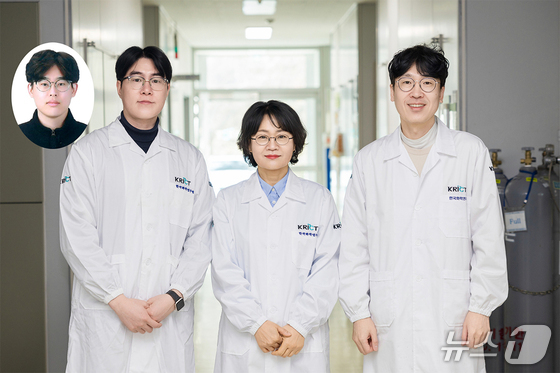
This groundbreaking work was published in the international materials science journal Advanced Composites and Hybrid Materials. Dr. Jeong Myeong-hoon and Dr. Park Byoung-wook from the Korea Research Institute of Chemical Technology served as first authors, with Dr. Kang Young-hoon and Dr. Han Mi-jeong as corresponding authors.
The research received support from the Korea Research Institute of Chemical Technology (KRICT) Basic Research Program, the Ministry of Small and Medium Enterprises (SMEs) and Startups’ Technology Development Program, and the Global Korea Scholarship (GKS) for Graduate Degrees.