
Thursday, April 9, 2026

Stock Rallies Worldwide, Could This Be the ‘Powell Effect’?

The U.S. Federal Reserve's decision to maintain...

Kim Jong Un’s Regime Uses Sports Diplomacy to Re-enter Global Stage Amid US Pressure

North Korea plans to send a delegation of 260-270 members to the 2026 Aichi-Nagoya Asian Games, including 150 athletes in 17 sports.

Navy Medic Gets 3 Years for Stealing Secret Codes

22-year-old man found guilty of trespassing into the Naval Operations Command medical office nine times over two months.

AI Voice Restoration: How New Tech Helps Patients Regain Their Voices

TechAI Voice Restoration: How New Tech Helps Patients Regain Their Voices
On April 2, a research team led by Professor Park Sung-min from the Department of IT Convergence Engineering, the Department of Mechanical Engineering, and the Department of Electronic and Information Engineering at POSTECH developed a voice restoration technology that uses AI to reconstruct actual speech. From left: Professor Park Seong-min and Dr. Hong Seong-wook of the Department of Mechanical Engineering (Provided by POSTECH) 2026.4.2 / News1
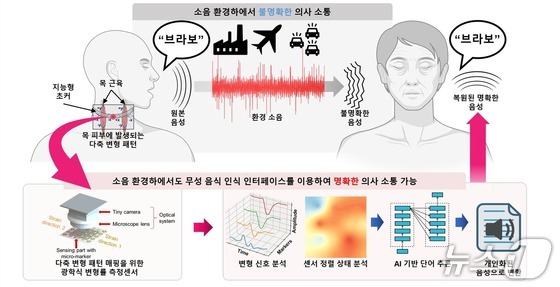
Silent Sound Restoration technology developed by a POSTECH research team (Provided by POSTECH) 2026.4.2 / News1

POSTECH announced on April 2 that Professor Park Sung-min’s research team has developed a groundbreaking technology called silent speech restoration, which uses artificial intelligence to recreate actual voice.

The research was initiated to find innovative ways for patients who have lost their voices due to vocal cord disorders or surgeries to communicate naturally.

The team’s cutting-edge technology combines artificial intelligence (AI) voice synthesis with a wearable sensor that precisely measures minute movements in the throat, enabling voice reproduction without the need for audible sound production.

Professor Park expressed hope that this advancement would accelerate the day when patients with vocal disabilities can reclaim their voices. He also noted that the technology’s applications could extend beyond helping those with vocal impairments, potentially revolutionizing communication in noisy industrial environments such as factories and construction sites.

Check Out Our Content

Check Out Other Tags:

Most Popular Articles