

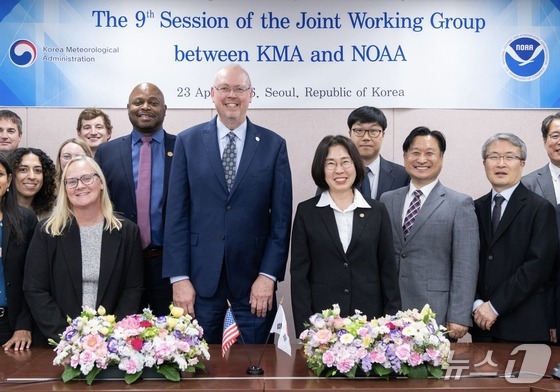
The Korea Meteorological Administration (KMA) convened the 9th Weather Cooperation Meeting with the U.S. National Oceanic and Atmospheric Administration (NOAA) in Seoul on April 23. The meeting aimed to expand collaboration on satellite, radar, and AI-based forecasting technologies.
The two agencies have maintained biennial cooperation meetings since signing a memorandum of understanding in 2005. This year’s meeting covered seven key areas of collaboration, including the development of next-generation weather satellites, utilization of satellite and radar data, numerical weather prediction models, and artificial intelligence (AI) applications.
Notably, the agencies agreed to share satellite payload technology, conduct joint research, facilitate expert exchanges, and organize joint workshops on AI-driven meteorological technologies. Following the meeting, the U.S. delegation is scheduled to tour critical facilities, including the National Meteorological Satellite Center and the National Center for Meteorological Supercomputer.
NOAA Administrator Kenneth Graham emphasized the importance of enhancing forecasting capabilities and utilization skills in light of increasingly frequent extreme weather events. He expressed his anticipation for technological advancements through U.S.-Korea collaboration.
KMA Administrator Lee Mi-sun stated that the agency plans to leverage its competitive edge in numerical forecasting models and observational data to expand cooperation in satellite and AI technologies.