

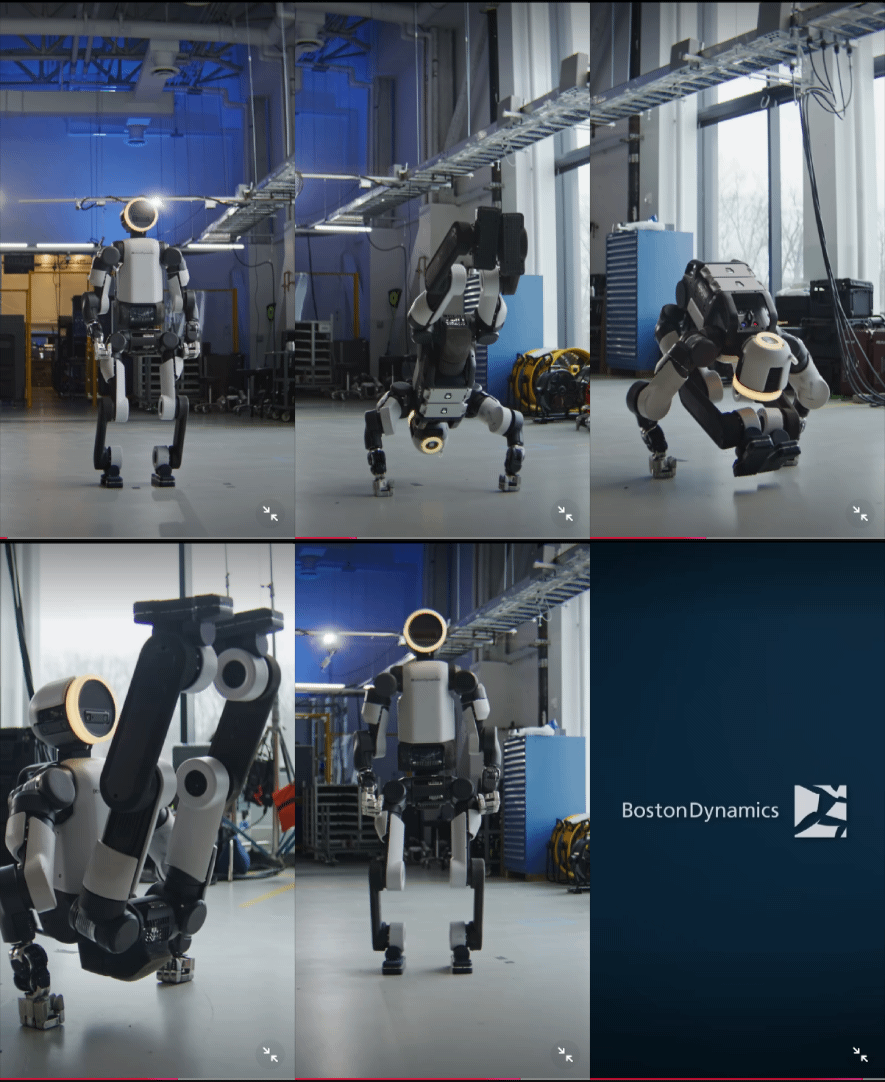
Boston Dynamics, a robotics subsidiary of Hyundai Motor Group, has created a stir by unveiling new footage of its humanoid robot, Atlas, executing intricate gymnastic moves that would challenge even skilled human athletes. What’s particularly noteworthy is that this robot is the first development model slated for actual industrial deployment, expected to play a pivotal role in implementing smart manufacturing solutions at Hyundai’s future factories.
On Tuesday, Boston Dynamics released a short video on its YouTube channel showcasing Atlas’s impressive gymnastic abilities. As the robot prepares for rigorous training in U.S. production facilities, viewers have been lavishing praise on its display of high-level maneuvers that push the boundaries of human capability.
The most significant aspect of this reveal is that the Atlas featured in the video is a development model, not a research prototype. This marks the first time Boston Dynamics has shared footage of an operational Atlas development model.
The video opens with Atlas executing a perfect handstand. It then transitions to a planche-like position, supporting its entire body weight on just its hands, before seamlessly flipping into an L-sit. This gymnastics move involves supporting the body with the hands while forming an L shape. After holding this challenging position for about five seconds, Atlas dynamically flips back up to a standing position.
The gymnastic sequence demonstrated by Atlas goes well beyond basic balancing or repetitive motions. It demands precise, simultaneous control of the upper body, core, and arm joints. The footage captures Atlas effortlessly supporting its full weight on a minimal hand surface area, showcasing Boston Dynamics’ cutting-edge technological prowess.
This performance confirms Atlas’s capacity to handle heavy lifting, transportation tasks, and work in unconventional postures within real manufacturing environments.
The movements were powered by reinforcement learning-based whole-body control technology. This innovative approach enables the robot to develop its movement and balance strategies through extensive simulations and trial-and-error processes. Notably, for complex actions involving continuous changes in contact states and posture transitions, this reinforcement learning-based control system offers superior flexibility.
At the Consumer Electronics Show (CES) event in January, the research model of Atlas garnered attention by introducing the development model, though the latter wasn’t operational at that time.
To underscore its status as the inaugural development model, Boston Dynamics prominently displayed the serial number 001 on Atlas’s torso in the video. This Atlas development model boasts autonomous learning capabilities and adaptability for diverse work environments, promising to maximize efficiency in real-world manufacturing settings.
Hyundai Motor Group has outlined plans to deploy the Atlas development model at its Hyundai Motor Meta Plant America (HMGMA), conducting thorough validations across various process units. The rollout will begin at the Georgia Hyundai Motor Meta Plant America in 2028, followed by implementation at the Kia Georgia plant (KaGA) in late 2029. The group aims to gradually expand Atlas’s presence to its global factories, targeting 16 key manufacturing processes to enhance safety, productivity, and quality. By 2030, Hyundai plans to ramp up production to 30,000 Atlas units annually.