Friday, May 15, 2026

Tensions Rise on Korean Peninsula as Marines Stage Amphibious Assault Drills

North Korea criticizes U.S.-South Korea marine drills as reckless provocations, claiming they escalate tensions on the Korean Peninsula.

Impact of Minister Chung Dong-young’s Comments on North Korea: 5 Key Insights

Rep. Yoon Sang-hyun criticizes Unification Minister Chung for misrepresenting North Korea's nuclear status, stressing security implications.

North Korea Declares South as Hostile Nation in Shocking Constitutional Changes

North Korea amended its constitution to label South Korea as hostile, escalating tensions and justifying road demolitions.

Workday Korea Says Becoming AI-Native Requires Structural Redesign, Not Add-On Tools

TechWorkday Korea Says Becoming AI-Native Requires Structural Redesign, Not Add-On Tools
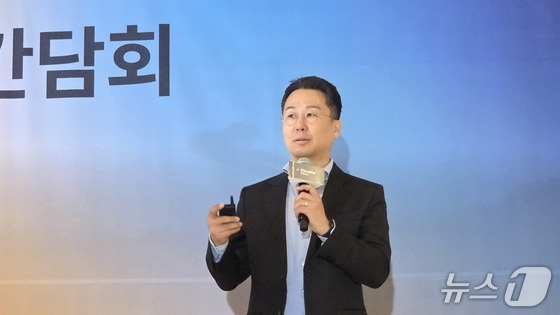
Heo Jeong-yeol, the new country manager of Workday Korea, speaks at a press conference held at The Westin Seoul Parnas Hotel in Gangnam-gu, Seoul 2026.5.14 / Provided by Workday Korea

Many global companies claim their business models must become AI-native, but transforming existing models into artificial intelligence (AI)-native ones is unfeasible.
Some firms suggest layering AI developed with Anthropic onto their models, but this is impractical. Heo Jeong-yeol, Workday Korea’s new country manager, addressed these limitations during the Workday Elevate Seoul 2026 press conference at the Westin Parnas Hotel in Seoul on Thursday.

Heo noted that companies using legacy systems like SAP for enterprise resource planning (ERP) and human capital management (HCM) face innovation challenges.

He emphasized that transitioning to AI-native models requires redesigning core structures. Existing models struggle with innovation due to outdated architectures and data structures, Heo explained. To become AI-native, businesses need AI-friendly contexts and architectures with well-designed ontologies. Many firms hit roadblocks in AI transformation because of these hurdles.
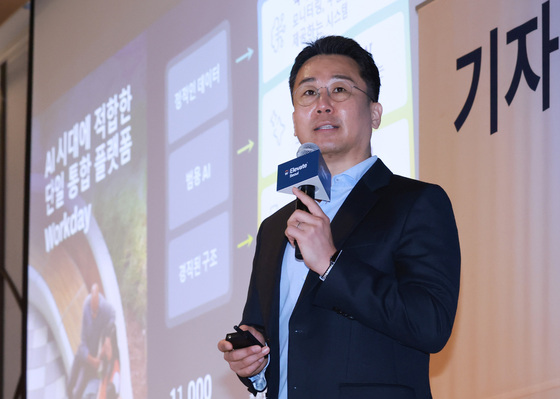
Heo Jeong-yeol, the new country manager of Workday Korea, speaks at a press conference held at The Westin Seoul Parnas Hotel in Gangnam-gu, Seoul 2026.5.14 / Provided by Workday Korea

Heo pointed out AI’s limitations in critical areas like corporate accounting and payroll, where errors are unacceptable. Effective enterprise AI must balance reasoning with established policies in a unified system, he stated.

He criticized the approach of adding external AI as an afterthought, saying it shifts risks to customers. In contrast, Heo highlighted Workday’s integrated architecture that combines data, logic, and security from the ground up.

Addressing Workday’s low adoption rate in Korea, Heo suggested the company’s capabilities are underestimated locally. He expressed confidence in Workday’s ability to lead AI-driven business transformations.
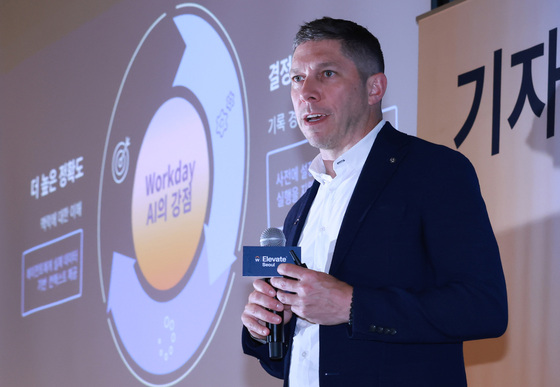
Josh Zywien, Vice President of Global Solutions Marketing at Workday, speaks at a press conference held at The Westin Seoul Parnas Hotel in Gangnam-gu, Seoul 2026.5.14 / Provided by Workday Korea

Josh Zywien, Workday’s Vice President (VP) of Global Solution Marketing, added that while generative AI excels at reasoning and pattern recognition, its probabilistic nature can’t guarantee accuracy – a key concern for businesses.

Workday proposed combining probabilistic AI with deterministic processes to address these issues. This approach aims to balance AI’s flexible reasoning with deterministic guardrails that enforce company policies and compliance, ensuring both accuracy and automation.

Zywien stressed that even advanced AI can be risky if it operates outside company guidelines and authority structures. All AI actions must follow predefined policies and processes. It’s crucial to prevent abnormal AI behavior like unauthorized data access.
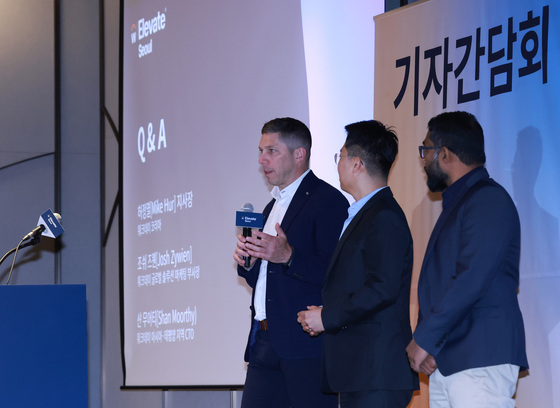
From left to right, Josh Zywien, Vice President of Global Solutions Marketing at Workday; Heo Jeong-yeol, the new Country Manager of Workday Korea; and Shan Moorty, CTO of Workday Asia-Pacific, are participating in a Q&A session / Provided by Workday

Check Out Our Content

Check Out Other Tags:

Most Popular Articles