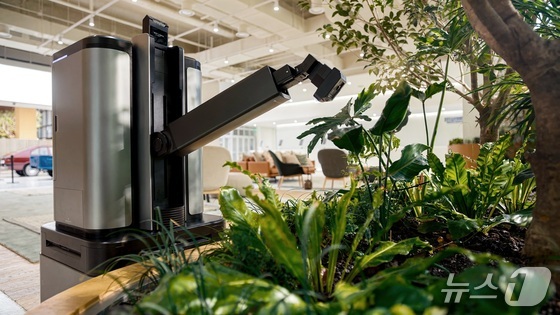
Robots autonomously water plants, deliver beverages, and patrol the office building.
After approximately two years of construction, Hyundai Motor Company and Kia have transformed their Yangjae office in Seoul’s Seocho district into an expansive robot testing ground. Three types of robots—for irrigation, delivery, and security—now navigate the premises, working in harmony with employees. The concept of a robot-friendly building has truly come to life here.
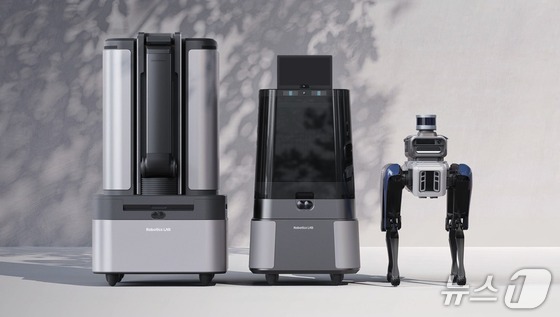
During the visit to the Yangjae office on Thursday, there were three newly developed robots from Hyundai and Kia in action: the DAL-e Gardener for irrigation, the DAL-e Delivery for beverage transport, and SPOT for security and protocol. These robots seamlessly assist employees in their daily tasks.
The integration of these robots underscores Hyundai and Kia’s commitment to fostering an environment where employees naturally coexist with robotic assistants, advancing their position as leaders in human-centered physical artificial intelligence (AI).
The DAL-e Gardener supports landscape management by watering various plants throughout the office. Using an array of sensors, it creates a three-dimensional map of its surroundings, distinguishing between plants, soil, and flowerbeds. The robot features a versatile arm capable of six-axis rotation and height adjustment for precise watering.
Equipped with a Plug & Drive (PnD) module for stable movement and advanced sensor fusion technology combining cameras and Light Detection and Ranging (LiDAR), the robot navigates crowded areas like the lobby with ease, autonomously avoiding obstacles en route to its destination.
When its water supply runs low, the robot communicates with the building’s water system to automatically refill. It also self-drains any remaining water to maintain hygiene, minimizing the need for human intervention.
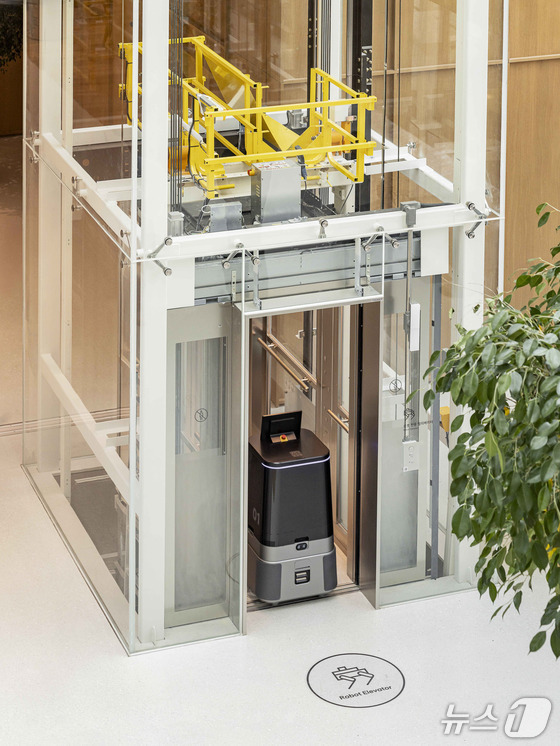
The DAL-e Delivery robot transports beverages from the ground floor café to designated pickup zones on each floor. Employees order drinks via a mobile app, and the robot retrieves and delivers them to the specified location. Capable of carrying up to 16 drinks at once, it uses facial recognition to ensure accurate delivery.
Like its gardening counterpart, the DAL-e Delivery employs PnD modules and sensor fusion technology, enabling it to navigate complex environments and avoid obstacles autonomously.
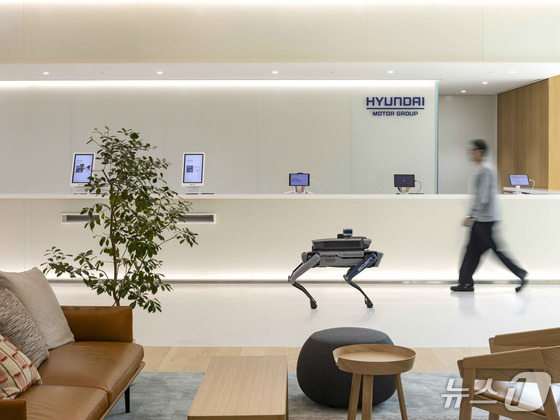
The security robot SPOT, based on Boston Dynamics’ quadruped design, features an additional autonomous driving module developed by Hyundai and Kia’s Robotics Lab. This enhancement allows SPOT to perceive its environment and move independently.
Deployed throughout the office, SPOT will conduct building patrols, providing continuous security monitoring through its autonomous capabilities.
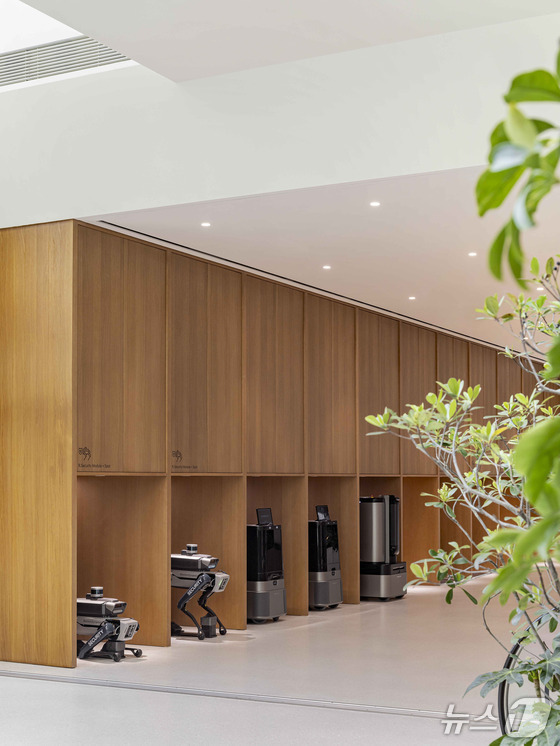
To create a robot-friendly environment, Hyundai and Kia have installed dedicated waiting areas and elevators for the robots. When battery levels are low, the robots automatically recharge at the first-floor Robot Station, resuming tasks as needed and using dedicated elevators for inter-floor travel.
Beyond the three robot types, Hyundai and Kia have implemented a facial recognition system called Facey throughout the building, streamlining security procedures. The DAL-e Delivery integrates with Facey, identifying customers without additional authentication steps.
The NARCHON integrated control system enables centralized management of the diverse robot fleet. Managers can access NARCHON via a web app from any location, monitoring real-time robot locations, status, and charging information.
The system also facilitates easy scheduling and location control, allowing efficient management of multiple robot types.
These innovations have earned Hyundai and Kia’s Yangjae office technical validation from UL Solutions, a global safety certification organization, confirming its status as a robot-friendly building.
Hyundai Motor Group Chairman Euisun Chung commented that it hopes these robots help the employees align with the company’s vision. Their activities provide immediate insights into the robots’ strengths, weaknesses, and areas for improvement. This office will serve as an invaluable testing ground.
A Hyundai and Kia spokesperson added that in this human-robot collaborative space, employees naturally experience cutting-edge robotics technology. It aims to expand areas where robots enhance convenience, leveraging the advanced robotics capabilities.
Hyundai and Kia’s Robotics Lab continues to test the DAL-e Delivery in various settings, including Seoul’s Factorial Seongsu and Hallym University Hospital, further exploring human-robot coexistence.