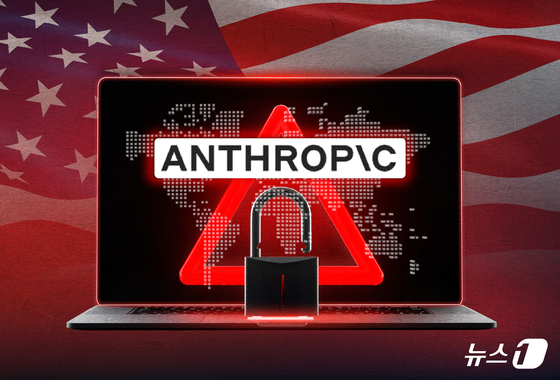
The U.S. government has banned the export of cutting-edge artificial intelligence (AI) models, sparking renewed interest in developing Sovereign AI – domestically built and controlled AI systems that reduce reliance on foreign technology.
Anthropic reported on Monday that the U.S. government recently halted foreign access to its most advanced AI models, Claude Mythos 5 and Claude Fable 5, through new export control guidelines.
These top-tier models were unveiled on June 9. Mythos, a high-performance AI, has been offered with restrictions due to potential misuse concerns. Fable 5 is a publicly available version of Mythos with added safety features.
Security experts believe Mythos can identify vulnerabilities in major operating systems and browsers, as well as generate attack codes.
The cybersecurity industry warns that Mythos could potentially discover and exploit zero-day vulnerabilities – flaws without existing security patches.
If AI can find and exploit vulnerabilities faster than security patches can be developed, it could render current defense systems ineffective.
Given these concerns, Anthropic has limited Mythos access to key infrastructure companies and institutions through initiatives like Project Glasswing, rather than making it publicly available.
Project Glasswing is a cybersecurity collaboration between Anthropic and select countries and companies, using Claude Mythos Preview to detect and defend against software vulnerabilities.
The project involves 150 institutions from 15 countries. In South Korea, participants reportedly include the Korea Internet & Security Agency (KISA), Samsung Electronics, SK Hynix, and SK Telecom.
However, the U.S. government’s ban on foreign nationals using Mythos is expected to disrupt South Korean companies’ involvement in Project Glasswing.
A Ministry of Science and Information and Communications Technology (ICT) spokesperson stated they are in ongoing communication with Anthropic to clarify the situation.
These international developments have intensified discussions about implementing Sovereign AI – AI infrastructure built and controlled independently by a nation without external dependencies.
This initiative aims to prevent technological dependence and protect data sovereignty. The government plans to secure Sovereign AI through a National Representative AI project to develop domestic foundation models.

The rapid advancement of AI capabilities, coupled with U.S. export controls, has amplified industry calls for independent AI infrastructure.
Deputy Prime Minister and Science Minister Baek Kyung-hoon stressed the need to develop domestic frontier model capabilities in light of the Mythos shock.
Baek emphasized on social media that strategic autonomy requires the ability to independently develop and operate AI when necessary, beyond merely adopting foreign technology.
He argued that long-term reliance on foreign big tech models for critical national infrastructure and industrial security poses significant risks, necessitating preparation for AI security sovereignty.
Ha Jung-woo, former Chief Presidential Secretary for AI Future Planning, described the U.S. export controls as a consequence of AI technology dependence.
Ha noted that such situations could recur, underscoring the importance of developing domestic AI capabilities, or Sovereign AI.
Naver Cloud Chief Technology Officer (CTO) Seong Nak-ho urged preparation for a scenario where the U.S. restricts access to AI intelligence while partially allowing access to AI products.
Seong stressed that now is the critical time to secure strategic resources, advising South Korea to leverage its AI development capabilities and memory semiconductor expertise.