

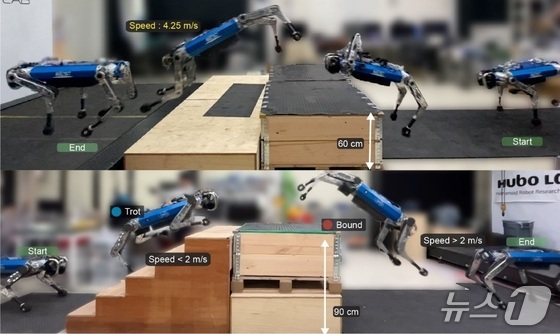
On Thursday, Professor Park Hae-won and his research team from Korea Advanced Institute of Science and Technology’s (KAIST) Department of Mechanical Engineering unveiled a groundbreaking control technology for quadrupedal robots. This innovation enables the robots to autonomously select and switch between various locomotion techniques—including walking, running, and jumping—allowing for swift and stable movement in outdoor environments.
The team employed Action Pre-training-based Transformer Reinforcement Learning (APT-RL) technology, empowering robots to seamlessly combine different locomotion methods in complex outdoor settings. This cutting-edge approach generates 15.5 hours of training data in a mere 8 minutes through computer simulations, significantly outpacing traditional motion capture-based learning methods in speed and efficiency.
The newly developed control technology was successfully implemented in KAIST’s proprietary quadrupedal robot, HOUND. The robot demonstrated its ability to navigate both indoor obstacle courses and unpredictable outdoor terrains, such as the KAIST campus and forest trails, by dynamically switching between locomotion techniques in real-time. Remarkably, HOUND achieved speeds of up to 22 km/h (approximately 13.7 mph) while traversing challenging terrains including stairs, grass, slopes, and obstacle-ridden landscapes.
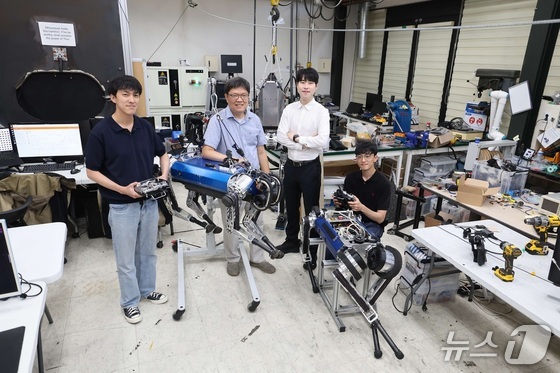
Professor Park emphasized the significance of this research, stating that this breakthrough demonstrates that quadrupedal robots can autonomously determine and adapt their locomotion methods in complex environments, both indoors and outdoors. It paves the way for the deployment of physical artificial intelligence (AI)-based walking robots in various challenging scenarios, including disaster response, military operations, and industrial facility inspections.
The study was featured as the cover article in the July issue of Science Robotics, one of the most prestigious scientific journals in the field. The research received support from the Ministry of Trade, Industry and Energy, the Korea Institute of Industrial Technology Planning and Evaluation, and the Agency for Defense Development.