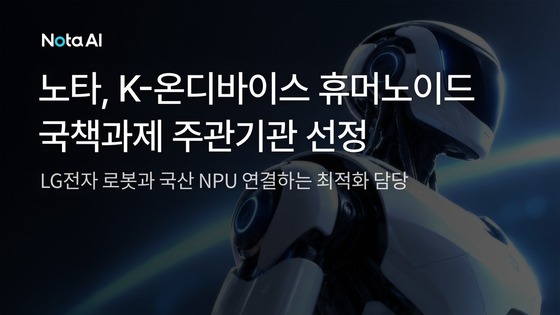
Nota, a company specializing in artificial intelligence (AI) model optimization, has been tasked with streamlining the Vision Language Action (VLA) model for LG Electronics’ humanoid robots. The firm will also customize the model for domestic neural processing units (NPUs). This crucial role involves fine-tuning the robot’s brain to run complex AI models in real-time.
Industry sources revealed on Tuesday that Nota has been chosen to lead the third sub-project in the humanoid sector of the K-On-Device AI Semiconductor Technology Development Project. This initiative is spearheaded by the Ministry of Trade, Industry and Energy and the Korea Institute for Advancement of Technology (KIAT).
The project aims to develop autonomous humanoids capable of navigating complex environments and performing human-like tasks using domestically produced on-device AI semiconductors.
LG Electronics will oversee the entire project and spearhead the humanoid system development. Mobilint will provide the domestic neural processing unit (NPU) for AI computations within the robot. Nota’s role is to create optimization software that efficiently runs AI models like the VLA, tailoring them to the NPU architecture and the robot’s operational environment.
The primary challenge lies in ensuring the VLA, which integrates the humanoid’s perception, decision-making, and action capabilities, operates swiftly and reliably within the robot itself.
The humanoid must process visual data from its cameras to understand its surroundings and objects, then determine appropriate actions. Any delay in this inference process could result in the robot failing to adapt to environmental changes, potentially compromising task accuracy and safety.
The VLA is a sophisticated model that simultaneously processes language, visual, and action data. Its substantial computational and memory requirements pose challenges for direct implementation in humanoids, where power, heat management, and processing resources are limited.
To tackle this, Nota plans to employ various techniques such as token compression, quantization, pruning, knowledge distillation, and layer-wise optimization. These methods aim to reduce the VLA’s size, computational demands, and memory usage while minimizing performance loss. The streamlined model will then be adapted to the Mobilint NPU’s architecture. Finally, the team will validate its real-time performance and resource efficiency in an integrated robotic environment.
Upon successful optimization, the humanoid is expected to rely less on external servers for data processing. Instead, it will feature an on-device AI system capable of independently perceiving its environment, making decisions, and taking action.
Nota aims to leverage its AI optimization expertise, honed in mobile, edge, and data center applications, to break new ground in physical AI.
Cha Myung-soo, Chief Executive Officer (CEO) of Nota, emphasized the significance of this project in applying their AI optimization technology to domestically produced NPU-based humanoids. He expressed the company’s commitment to expanding their technology applications and business opportunities across various sectors requiring real-time on-device AI, including robotics, automotive, and industrial equipment.