

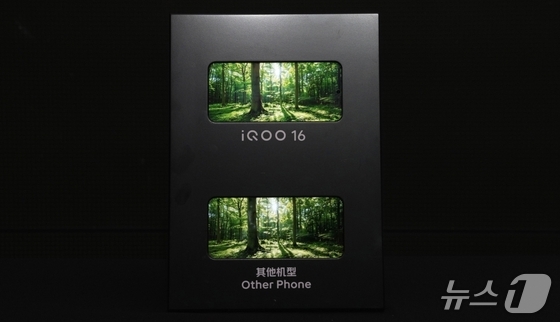
Samsung Display has developed the world’s first smartphone organic light-emitting diode (OLED) display that combines 2K resolution with a 165-hertz (Hz) refresh rate. The new panel delivers high resolution and fast screen transitions while reducing power consumption, as the company seeks to strengthen its position in the high-performance gaming smartphone market.
Samsung Display said Sept. 14 that it developed a 6.9-inch 2K, 165Hz OLED panel and will supply it to iQOO, the premium brand of Chinese smartphone maker Vivo, for its iQOO 16 gaming smartphone, which is set to debut this month.
Compared with recently launched high-end gaming smartphone OLED panels that offer 1.5K resolution and a 165Hz refresh rate, the new product raises resolution to 2K while maintaining the same refresh rate. Power consumption for the display is about 30% lower.
Maximum brightness reaches 2,800 nits in high-brightness mode (HBM). When the On Pixel Ratio (OPR), which refers to the proportion of pixels actually emitting light across the display, is 1%, brightness can reach up to 10,000 nits.
According to industry sources, demand is growing for smartphones that combine sharp image quality with fast screen transitions as high-end mobile games and high-resolution content become more widespread. As resolution and refresh rates increase, the number of pixels and drive circuitry that must be processed also rises, making it a sign of technological competitiveness to achieve both high brightness and power efficiency.
To achieve 165Hz at 2K resolution, the display must show a new frame approximately every 6 milliseconds (ms). This requires technology capable of rapidly and precisely charging and driving numerous pixels within a short period.
Samsung Display optimized its driving, emission and image-quality technologies across the board. To improve driving performance, it applied a precision design that increased the thickness of pixel signal wiring by 10% from the previous design. Expanding the cross-sectional area through which current flows lowers resistance and increases pixel charging speed.
For the display driver integrated circuit (DDIC) that controls each pixel, Samsung Display applied a 22-nanometer (nm) IC process, finer than the existing 28nm process. The new process reduces the drive chip’s computing power consumption by 30% compared with the previous generation, helping ensure fast and stable driving performance.
For improved light emission and image quality, Samsung Display applied its latest organic materials and LEAD™, a polarizer-free OLED technology optimized for the driving environment. Eliminating the polarizer reduces light loss, allowing the display to achieve lower power consumption while maintaining high brightness.
Samsung Display also applied its “AI-based image-quality optimization technology,” accumulated over three years, to improve brightness and color uniformity.
Samsung Display said the technology can improve smartphone display image quality and response speed while reducing the burden of battery consumption. It is expected to improve both display performance and battery life in smartphones used for extended periods of high-end gaming.
Lee Ho-jung, executive vice president and head of Samsung Display’s Product Planning Team, said, “We have concentrated our world-leading OLED technology to achieve high resolution and a high refresh rate, high brightness and power efficiency at the same time,” adding, “Based on the differentiated competitiveness of Samsung OLED, optimized for high-end games that require fast screen transitions and long play sessions, we will continue to strengthen our technology leadership in the premium smartphone market.”