On Monday, the Korea Advanced Institute of Science and Technology (KAIST) announced the development of a small soft robot called BeetleBot. This innovative creation resulted from a collaborative effort between Professor Kim Sang-wook’s research team at KAIST, Professor Wei Gao’s team from the California Institute of Technology (Caltech), and Professor Hirotaka Sato’s team from Nanyang Technological University (NTU) in Singapore.
For robots to adapt to their surroundings effectively, they need to integrate movement and sensing capabilities, much like humans do. However, soft robots, which use flexible materials, have faced challenges in this area. Often, their actuation, sensing, and control functions are implemented separately or require complex mechanisms, making it difficult to consolidate these features into a compact robot.
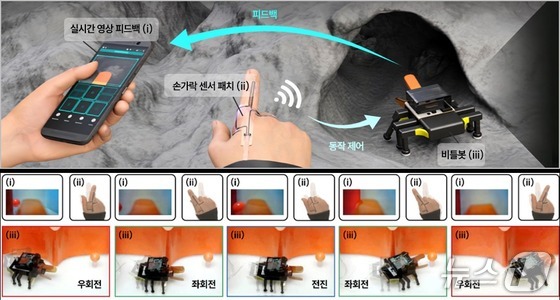
To address this challenge, the research team designed BeetleBot with artificial muscles that contract like biological muscles, enabling it to walk and grasp objects. They integrated a camera, pressure sensors, and elastic sensor patches on the robot’s fingers, allowing users to monitor the robot’s environment and its interactions with objects in real-time.
The team’s approach was inspired by nature. They began by analyzing the relationship between a beetle’s leg muscles and joint movements, incorporating these insights into BeetleBot’s artificial muscle placement and leg structure. Using three-dimensional (3D) printing technology, they created artificial muscles from liquid crystal elastomers (LCE), a polymer that contracts when heated. These muscles were combined with an actuation module that generates heat electrically. By independently controlling each artificial muscle and fine-tuning the sequence of operations, the team achieved forward movement and directional changes.
Taking cues from a beetle’s large jaws used for capturing prey, the researchers developed a Soft Gripper. This innovative gripper incorporates artificial muscles and pressure sensors, enabling it to grasp objects and detect contact.
The gripper’s operation is elegantly simple yet effective. When the artificial muscles contract, the gripper closes to grasp an object. Simultaneously, the pressure sensor detects the force applied during contact. This sensor works on the principle that when an object presses against it, the distance between internal electrodes changes, altering their electrical characteristics and thus confirming contact.
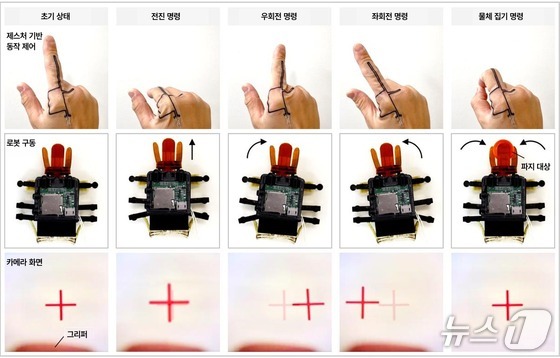
To control BeetleBot, the team developed an intuitive interface using elastic sensor patches that respond to finger movements. As a user bends their finger, the patch stretches, altering the conductive pathway of the embedded carbon nanotubes (CNTs). This change produces distinct resistance signals, which the team categorized into four commands: forward, left turn, right turn, and object grasping. These commands are then transmitted to BeetleBot via Bluetooth, prompting the corresponding actions.
The system incorporates a bidirectional feedback mechanism. Users can view the robot’s surroundings through its onboard camera and receive tactile feedback from the gripper’s pressure sensors. This real-time information allows users to make informed decisions about the robot’s next move, which they can then input through finger movements.
In a demonstration of BeetleBot’s capabilities, the research team showcased its ability to navigate around obstacles, approach target objects, and successfully grasp and transport them. This demonstration effectively integrated walking, object manipulation, visual and tactile sensing, and user control into a single, cohesive system, highlighting the potential of small soft robots in performing complex tasks.
The implications of this breakthrough are far-reaching. It lays the groundwork for developing remote-controlled soft robots capable of operating in hard-to-reach spaces, potentially revolutionizing fields such as search and rescue, environmental monitoring, and industrial inspections. However, the research team acknowledges that further improvements are needed to expand its applications. These include enhancing the actuation speed and energy efficiency of the artificial muscles, as well as refining the power supply system. Additionally, rigorous testing in real-world environments will be crucial to validate the robot’s performance under various conditions.
Looking ahead, the researchers aim to integrate this technology with physical artificial intelligence (AI), creating soft robots that can adapt their movements based on their environment and the objects they interact with. This advancement could lead to more autonomous and versatile soft robotic systems.
This groundbreaking research, with Dr. Kim In-ho from Sungkyunkwan University (formerly a postdoctoral researcher at Caltech) as the lead author, has been published in the prestigious international journal Science Advances, marking a significant milestone in the field of soft robotics.