Kakao Mobility has released research findings showing that its artificial intelligence (AI)-powered parking technology reduced intervals between vehicle departures by up to 20%.
The company said on the 23rd that it participated as an official sponsor of the 2026 Gangneung ITS World Congress, held in Gangneung, Gangwon Province, from the 19th to the 23rd, showcasing AI- and data-driven mobility technologies and research achievements.
The ITS World Congress brings together government officials, businesses and academic representatives from around the world to discuss the future of transportation technologies, including AI and autonomous driving, as well as opportunities for international cooperation. This year’s event marked the third time South Korea has hosted the congress, following Seoul in 1998 and Busan in 2010, and the first time in 16 years. A total of 108 domestic and international organizations and companies participated in this year’s exhibition, occupying 428 booths.
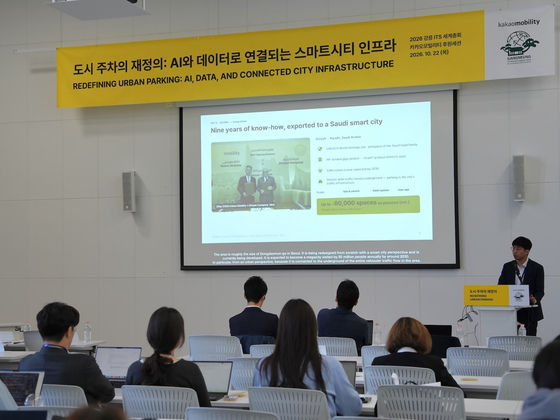
On the 22nd, Kakao Mobility held a dedicated parking session titled “Redefining Urban Parking: Smart City Infrastructure Connected by AI and Data.”
At the session, Kim Geon-woo, head of Kakao Mobility’s Future Platform Economy Research Institute, presented an analysis of approximately 1.62 million parking-related data points and said platform-based parking technology had reduced intervals between vehicle departures by up to 20%.
Park Eun-ho, head of Kakao Mobility’s P&C Business Division, outlined the company’s business achievements since the launch of its Kakao T parking service in 2017, including efforts to connect parking facilities nationwide through a unified platform built on digital platforms, operations and equipment.
Seo Jeong-hoon, director of Kakao Mobility’s Deep AI Team, showcased AI technologies that use cameras to recognize license plates and parking spaces, along with indoor and outdoor three-dimensional (3D) spatial mapping and digital twin technologies.
Kakao Mobility also presented its plans to build parking infrastructure that uses these technologies to monitor and manage individual parking facilities and vehicle movements in real time.
The company also participated in technical and academic sessions throughout the congress to share mobility technologies and data-driven research findings. For international visitors, it provided transportation assistance using k.ride, its mobility service designed for foreign users.
Hwang Yun-young, head of Kakao Mobility’s Compliance Management Division, said, “The Gangneung ITS World Congress was a meaningful opportunity to share Kakao Mobility’s AI and data capabilities and research achievements with transportation professionals from around the world.” Hwang added, “We will continue to advance parking technology, which is essential infrastructure supporting urban transportation and will serve as a hub for future mobility in the era of autonomous driving, while actively expanding into global markets.”