

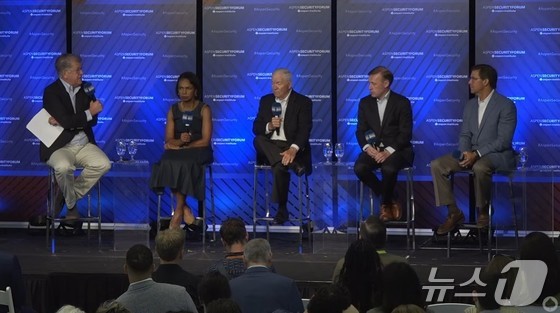
Mark Esper, who served as Secretary of Defense during Donald Trump’s first administration, recently reflected on a sobering realization he had in 2017. While preparing for a potential conflict with North Korea, Esper discovered significant vulnerabilities in the U.S. defense industrial base, particularly its capacity to sustain a prolonged war.
Speaking at the Aspen Security Forum in Colorado on July 18, Esper recounted his experiences as Army Secretary in 2017. During that time, he oversaw preparations to deploy troops, ammunition, and equipment to the Korean Peninsula, given the heightened tensions with North Korea.
Esper explained that the U.S. began quiet preparations, assessing the real possibility of war with North Korea. When he reviewed ammunition stockpiles, it became clear that they were woefully unprepared for an extended conflict. He asked his staff about contingency plans, and they simply responded that they would just order more.
Drawing on his experience in the defense industry, Esper highlighted the complexity of modern weapons production. He noted that today’s advanced systems are a far cry from the mass-produced armaments of the 1940s. He further pointed out that these cutting-edge weapons often cost millions and can take months, if not years, to manufacture.
Esper admitted that it took time for the full implications to sink in, stating that the we realized we didn’t fully understand what was needed for a protracted conflict in this new era of great power competition, particularly with China. He stated that this issue demands attention from all stakeholders and we need strong leadership at the highest levels to address it, emphasizing the urgent need for stockpiling ammunition.
In his 2022 memoir, Esper further detailed these concerns. He wrote about witnessing firsthand the limitations of military procurement systems and insufficient defense industry production capacity shortly after becoming Army Secretary in November 2017.
The year 2017 marked a peak in North Korean provocations. In July, Pyongyang claimed a successful test of the Hwasong-14 ICBM. September saw their sixth nuclear test, followed by the launch of the Hwasong-15 in November, with North Korea boasting it could now strike the U.S. mainland.
Condoleezza Rice, Secretary of State from 2005 to 2009 under President George W. Bush, also participated in the Aspen panel. She highlighted how globalization has eliminated certain job categories and outpaced technological adaptation in some sectors.
Rice argued that these economic shifts have fueled the rise of populism, nationalism, isolationism, and protectionism. She urged that we must critically examine the root causes of these societal reactions and strategize on how to address them.
When the discussion turned to America’s involvement in seemingly endless conflicts in the Middle East such as Iraq and Afghanistan, Rice pointed out that, technically, their longest-running conflict remains the Korean War.
She elaborated that the U.S. is still operating under a ceasefire agreement on the Korean Peninsula, with tens of thousands of U.S. troops maintaining a constant presence there.
Robert Gates, who served as Secretary of Defense from 2006 to 2011 under both Bush and Obama, also weighed in at the forum. He identified bureaucratic inefficiencies at the Pentagon and congressional complacency as major factors undermining U.S. military competitiveness.
Jake Sullivan, National Security Advisor in the Biden administration, stressed the critical need for the U.S. to regain its edge in rapid, large-scale manufacturing to effectively compete with China.
Sullivan cautioned against oversimplification, stating that reshoring U.S. industry is far more complex than any military operation. He pointed out that it’s not as simple as Trump snapping his fingers and seeing factories materialize overnight.
He emphasized the intricate nature of the task, calling for a coordinated effort across all levels of government, the private sector, and bipartisan cooperation.
The Aspen Security Forum, now in its 16th year, has been a cornerstone of bipartisan security discussions since its inception in 2010.
This year’s four-day event, which kicked off on July 15, brought together approximately 1,000 current and former officials, along with experts in diplomacy and security. Key topics included U.S.-China strategic competition, artificial intelligence, cybersecurity, space security, and the intersection of industrial and economic security concerns.