

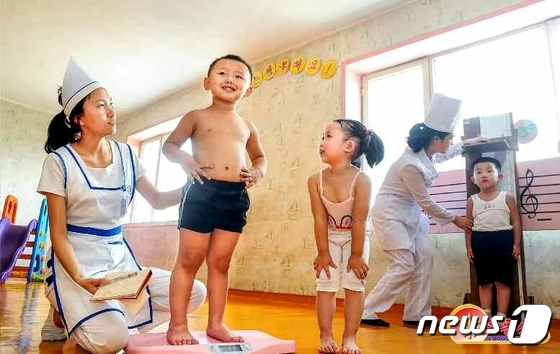
North Korea has stressed the importance of standardizing educational furniture while also disclosing the average height ranges for students from kindergarten through to university. The country released comprehensive average figures, apparently to avoid exposing the differences in physical development between children and adolescents in North Korea and South Korea.
According to the January issue of the monthly magazine Korean Architecture, published on Tuesday, North Korea addressed the specifications required for educational sector furniture and advocated for a diverse approach to furniture design. The magazine noted that to elevate educational supplies to global standards, it is essential to establish furniture specifications appropriate for each educational level, and provided height ranges by grade.
North Korea reported that the average heights are 100-120 cm (about 3.3-3.9 ft) (for kindergarteners, 110-150 cm (about 3.6-4.9 ft) for elementary school students, 130-160 cm (about 4.3-5.2 ft) for junior middle school students, 150-170 cm (about 4.9-5.6 ft) for senior middle school students, and 155-180 cm (about 5.1-5.9 ft) for university students.
However, these figures are given in broader ranges compared to South Korea, making it challenging to regard them as true averages. This discrepancy might be due to regional and institutional differences in the measurement methods, or it could be an intentional strategy to design larger, more durable furniture for educational institutions.
As of 2024, the Korea Disease Control and Prevention Agency (KDCA) reported the following average height ranges for South Korean children and adolescents: 101.1-114.6 cm (about 3.3-3.8 ft) for kindergarteners (ages 4-6), 121.4-153.3 cm (about 4-5 ft) for elementary school students, 157.8-170.9 cm (about 5.2-5.6 ft) for middle school students, 161.3-174.4 cm (about 5.3-5.7 ft) for high school students, and 161.8-176 cm (about 5.3-5.8 ft) for university students (ages 19-24).
Data on North Korean defectors who entered North Korean Refugees Resettlement Support Center (Hanawon) over the past decade indicate that the average height for 15-year-old male defectors is 156.5 cm (about 5.1 ft), while for males in their 20s it is 165.4 cm (about 5.4 ft). This represents a difference of about 10 cm (about 0.3 ft) compared to the South Korean averages of 170.9 cm (about 5.6 ft) for 15-year-old males and 174.4 cm (about 5.7 ft) for males in their 20s.
In South Korea, the Ministry of Health and Welfare, the KDCA, and the Ministry of Education release annual height statistics through the Student Health Examination Sample Statistics and the National Health and Nutrition Survey. It remains unclear whether North Korea is able to carry out similar systematic measurements.
Furthermore, disparities in physical development in North Korea may widen considerably due to varying standards of living. The Ministry of Foreign Affairs reported that 45.5% of North Koreans experienced nutritional deficiencies between 2020 and 2022.
Korean Architecture highlighted that standardizing the design of furniture for educational institutions is crucial for improving children’s living conditions. It emphasized that standardization enables faster mass production, enhanced quality, and reduced costs.
Recently, North Korea has demonstrated a move towards unifying production specifications across various fields. The Rodong Sinmun recently reported that the Ministry of Local Industry has implemented a new nationwide school uniform production method, incorporating a three-dimensional sizing system based on height, chest, and waist measurements. Researchers from the Clothing Research Institute established this system using data from 60,000 students.