

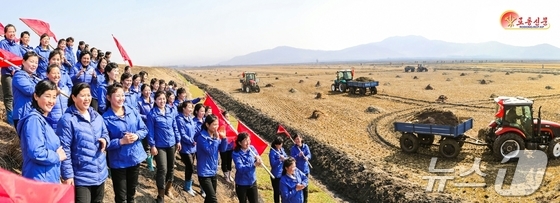
Women have equal rights with men in all domains of national, economic, cultural, social, and political life. This reflects the first article of North Korea’s Gender Equality Law, enacted 79 years ago. On July 30, 1946, North Korea established the Gender Equality Law, which guarantees women’s voting rights, candidacy rights, opposition to forced marriage, and the freedom to divorce. However, analysts suggested on Thursday that, in reality, the enhancement of women’s dignity and rights serves only as a propaganda tool to showcase the achievements of the three generations of leadership.
The North Korean Workers’ party’s official newspaper, Rodong Sinmun, reported Wednesday that July 30, 1946 marked the day when North Korean women, who had suffered from contempt and scorn under feudal customs and colonial rule, were reborn.
The newspaper explained that at that time, North Korean women could not participate in social and political life and lived under a medieval feudal family structure, enduring multiple layers of harsh exploitation, oppression, scorn, and misery under Japanese colonial rule.
Furthermore, Kim Il Sung remarked on the matter, saying that the issue of the rights of women, who make up half the population, is not merely about improving their conditions; it is an integral part of the North Korean revolution and one of its important historical tasks. He directed the establishment of the Anti-Japanese Women’s Association starting in 1926 and clearly stated the realization of gender equality in the Ten Principles of the National Liberation Association, thereby laying the historical foundations for the women’s liberation movement, as reported by the newspaper.
The article also referenced a speech delivered by Kim Jong Un at the 5th National Mothers’ Conference, highlighting that under wise leadership and nurtured attentively, North Korean women today are demonstrating their strength as a powerful force in the struggle for the comprehensive development and revival of the nation, and it praised Kim’s emphasis on women.
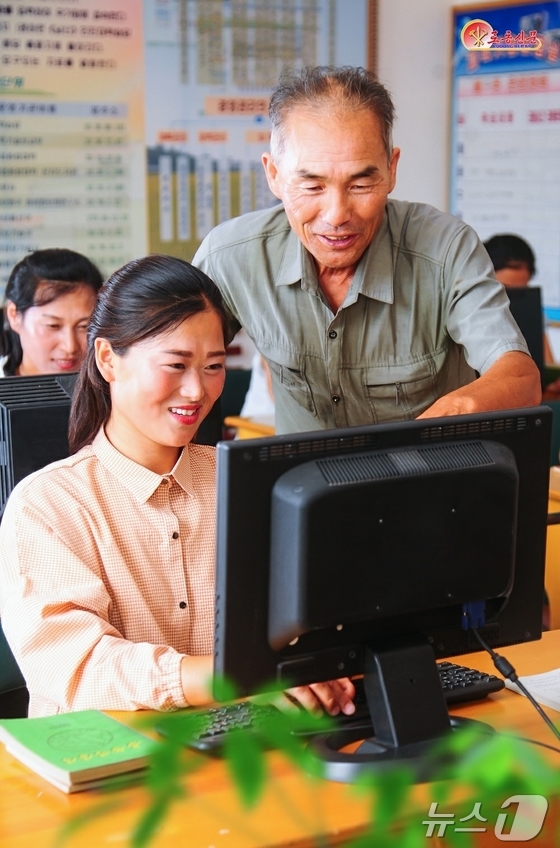
Since Kim Jong Un Took Power, the Establishment of Women Rights Laws Has Become More Active, With Experts Noting It Is a Response to International Criticism of Human Rights.
North Korea has long promoted women’s liberation as part of its socialist revolutionary achievements, using the enactment of laws like the Gender Equality Law to project a positive image of women in North Korean society to the international community. Notably, under Kim Jong Un’s rule, legislation related to women’s rights has accelerated. In 2010, North Korea enacted a law that further detailed women’s rights, which included provisions for gender equality in property inheritance, a prohibition on domestic violence, guarantees of freedom in childbirth, restrictions on night work for pregnant women, and bans on gender discrimination in wages and dismissals due to marriage or pregnancy. Additionally, in 2015, maternity leave was extended from 60 days before and 90 days after childbirth to 180 days after childbirth.
In 2016, North Korea submitted a comprehensive report on the implementation of the UN Convention on the Elimination of All Forms of Discrimination Against Women and received final observations from the UN Committee on the Elimination of Discrimination against Women (CEDAW) the following year.
Experts analyze that North Korea’s actions stem from a heightened movement for human rights criticism in the international community since 2010, suggesting that the regime required basic legal mechanisms to promote an image of being a gender-equal and human rights-progressing nation.
Additionally, since the mid-2010s, the expansion of the informal market economy of Jangmadang has allowed women to emerge as central figures in family livelihoods, indicating that the emphasis on women’s rights results partly from many women becoming laborers and economic agents.
Some Observers Are Noting a Potential Connection to the Successor Plan Involving Kim Ju Ae.
Kim Tae Won, a senior researcher at the Korea Institute for National Unification, stated that North Korea is strengthening state-led slogans, laws, and social campaigns for women’s mobilization, which may serve as motivational tools to encourage women to participate more actively in national goals, ideological education, and labor mobilization.
On the other hand, North Korea has recently highlighted women’s public activities and actively showcased images of female leaders in the media. Kim suggested that this could be related to the design of the successor plan involving figures like Kim Ju Ae, as well as an effort to project an image of social openness and dynamism.
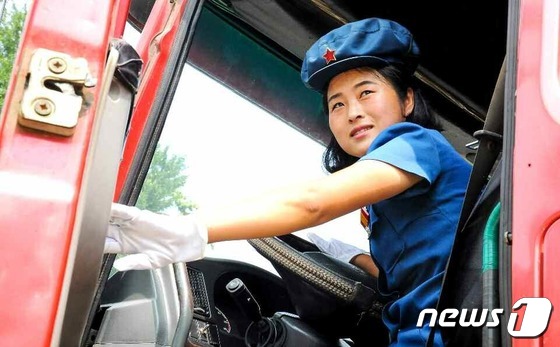
On August 15, 2021, Rodong Sinmun published an article about a female truck driver in Pyongyang, featuring a photograph of her in the driver’s seat. The article told the story of a young woman who became a truck driver, following in her father’s footsteps. Traditionally, driving was not considered a common occupation for women in North Korean households, but now women are recognized as capable drivers, thereby expanding their social roles.
Recently, North Korea has also been increasing exchanges with Russian women’s organizations. A North Korean delegation, led by Kim Jong Sun, a member of the Central Committee of the Workers’ Party, met with members of the Union of Women of Russia in Moscow on July 22nd, continuing the friendly exchanges between the two countries, as reported by Rodong Sinmun.