

Samsung Display announced on Wednesday that it will present 69 technical papers at the 25th International Meeting on Information Display (IMID 2025), held at Busan Exhibition and Convention Center (BEXCO) from Wednesday to Friday.
This represents the highest number of papers among participating companies, with 22 (32%) focusing on artificial intelligence (AI) and computer simulation research. Industry experts view this as a testament to Samsung’s AI research and development capabilities in display technology.
Key papers include, High-Performance AI-Based Image Resolution Enhancement Technology with Reduced Power Consumption, and, A Novel Approach to Predicting Corrosion Defects in OLED Panels.
Yoo Yongwook and his team from the AI division at the Global Technology Research unveiled an on-device AI technology. This innovation operates within a small chip (TCON) inside televisions or monitors, enabling real-time conversion of Full High Definition (HD) images to Ultra HD quality.
The core of this technology lies in its use of a miniaturized neural network, which minimizes display quality degradation and computational load while also reducing power consumption.
Park Hyun-seong and his team from the computer-aided engineering (CAE) division at the Samsung Display Research Institute proposed a new verification method. This technique rapidly predicts potential corrosion in organic light-emitting diode (OLED) panels through circuit simulations, thereby reducing the risk of panel failures.
Ha Dong-wan, Executive Director of Samsung Display’s Design Research Team, will deliver an invited session presentation on Ultra-High-Resolution OLEDs Using Red, Green, and Blue (RGB) Direct Patterning Technology.
This paper details research on a groundbreaking technique that directly patterns RGB pixels without color filters and employs ultra-precise pixel alignment. The result is crystal-clear OLED display quality without color loss.
Showcasing its prowess in OLED research and development, Samsung Display exhibited several cutting-edge prototypes this year. These include a 1.4-inch RGB OLED boasting an industry-leading 5000 pixels per inch (PPI) resolution and a 1.3-inch RGB OLED with an impressive 20,000 nits of brightness.
The company also highlighted its Electrically Pumped Quantum Dot (EL-QD) technology, which demonstrates a 34% brightness improvement over last year’s exhibits. Unlike conventional QD-OLED’s photoluminescent approach, EL-QD employs an electroluminescent method where QD pixels emit light directly without OLED components.
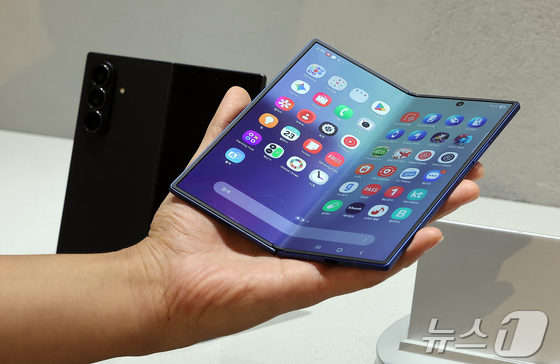
A Samsung Display spokesperson stated that its research and development (R&D) capabilities have directly enhanced its product competitiveness. The company also announced that the foldable OLED used in the main display of the Galaxy Z Fold Special Edition received the prestigious IMID Display of the Year Award.