

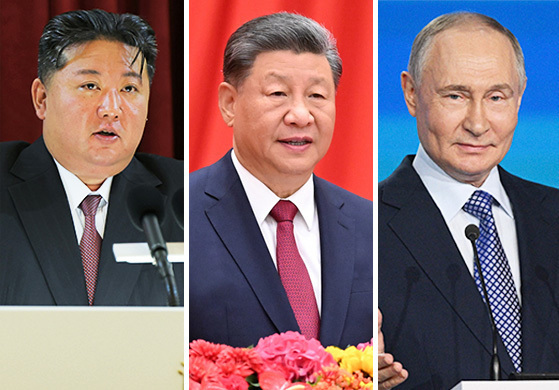
North Korean leader Kim Jong Un’s unprecedented attendance at China’s Victory Day celebration, commemorating the 80th anniversary of the triumph over Japan and fascism, is capturing global attention. All key aspects of this event are under intense scrutiny.
Xi Flanked by Kim and Putin… The Scene Itself Carries Strategic Significance
On Wednesday, at Beijing’s Tiananmen Square, the Victory Day parade will showcase Xi, Kim, and Putin standing side by side on the rostrum—a scene laden with significance for both domestic and international audiences.
The Kremlin has confirmed that President Putin will be positioned to Xi’s right, with Kim on his left. This arrangement was somewhat anticipated, as China’s Foreign Ministry had previously listed Kim immediately after Putin when announcing the 26 leaders attending the event.
Historically, China has maintained a cautious stance regarding the China–North Korea–Russia alignment. Chinese experts have consistently argued that initiating cooperation among these three nations—often seen as the onset of a new Cold War—does not serve China’s national interests.
Russia’s illegal invasion of Ukraine in 2022 and North Korea’s blatant violations of United Nations (UN) Security Council sanctions in pursuit of nuclear and missile development have labeled both as rogue states. Consequently, China’s cooperation with these countries has remained strictly bilateral.
In this context, seeing the leaders of North Korea, China, and Russia standing together and conversing on the Tiananmen rostrum is likely to put democratic nations such as South Korea, the U.S., and Japan on high alert.
The Kremlin has also disclosed that President Putin is considering a summit with Kim, suggesting a high probability of consecutive bilateral meetings between North Korea and Russia, as well as between North Korea and China.
However, experts generally agree that the likelihood of a trilateral summit among the three leaders is low. China’s reluctance to fully embrace this alliance persists, and reaching common ground for cooperative agreements among the three nations remains challenging.
Professor Park Won-gon of Ewha Womans University noted that while many media outlets are framing this as the beginning of a new Cold War and a South Korea–U.S.–Japan versus North Korea–China–Russia dynamic, China still resists being tied into a triangular alliance. Further noting that although the image of the three leaders on the Tiananmen rostrum will attract attention, China will likely avoid grouping North Korea and Russia together in future Victory Day press releases.
Focus Shifts to Potential Inter-Korean Interactions and Xi’s Political Standing
Observers are closely watching for any potential contact between North and South Korea during the event.
South Korea’s National Assembly Speaker, Woo Won-sik, will lead a delegation to the Victory Day ceremony. Seating arrangements on the Tiananmen Square rostrum are determined by diplomatic protocol. Despite Woo’s high-ranking position in South Korea, he is expected to be seated at a considerable distance from Kim, given the presence of other world leaders.
During China’s 70th Victory Day celebration in 2015, then-South Korean President Park Geun-hye and North Korean representative Choe Ryong Hae were seated far apart, with Choe assigned to the back rows.
While no direct encounters occurred between the two Koreas then, Kim’s attendance this year suggests a larger North Korean delegation, potentially increasing the chances of interaction.
Although there may be opportunities for encounters at separate events such as receptions—even if South Korean officials meet key North Korean figures like Kim Yo-jong—the likelihood of meaningful dialogue remains uncertain.
North Korea continues to adhere to its two Koreas policy and has expressed dissatisfaction with the conciliatory gestures of the Lee Jae-myung administration.
This Victory Day event is also likely to counter rumors of Xi’s political decline, which have been circulating in Western and Taiwanese media. Xi is expected to lead the People’s Liberation Army during the parade, with live global coverage reinforcing his authority.
Xi is anticipated to leverage this Victory Day to bolster internal unity and channel that momentum into the upcoming Fourth Plenary Session of the 20th Central Committee of the Chinese Communist Party, scheduled for October.