

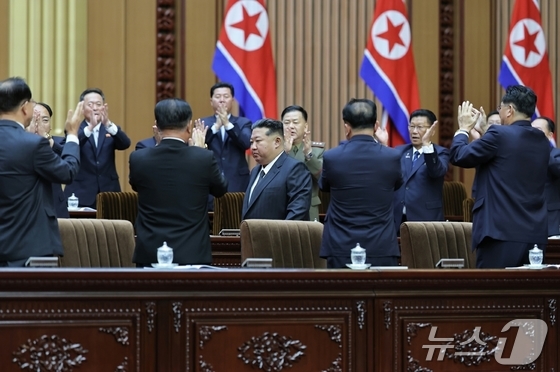
Kim Jong Un, the General Secretary of North Korea’s Workers’ Party, emphasized during his speech at the Supreme People’s Assembly, held over two days starting on September 20, that unification is absolutely unnecessary, reiterating the continuation of the two-state policy for North and South Korea. However, it has been confirmed that the plan announced last year to amend the constitution to reflect various aspects of the two-state policy has not yet been implemented.
The Workers’ Party’s official newspaper, Rodong Sinmun, reported on Monday that in his speech at the Supreme People’s Assembly, Kim stated that the reality is that two of the most hostile countries on Earth, engaged in war, have been sharply confronting each other on the Korean Peninsula. He added that the unification of two entirely opposed entities can only be achieved if one ceases to exist.
Kim stressed that discussing unification with an adversarial nation is merely an expression of complete obsession and dedication, and insisting on it will not change the reality. Further noting that has there ever been a case in world history where two hostile nations unified without one of them ceasing to exist? Why should we pursue a unification that necessitates one disappearing?
Nevertheless, Kim indicated that he would clearly establish through our laws that we and South Korea are two distinct nations separated by a border that can never become one, suggesting that the content related to the two-state system has not yet been reflected in North Korea’s constitution, known as the Socialist Constitution.
Kim first asserted the need to redefine inter-Korean relations as a two-state relationship during the Workers’ Party’s plenary meeting at the end of December 2023. This move is interpreted as a complete abandonment of the previous policy of unification and the approach toward South Korea, which treated the two Koreas as having special relations based on the concepts of unification and shared ethnicity, now designating South Korea as another country.
In January of last year, during the Supreme People’s Assembly, Kim redefined inter-Korean relations as the relationship between two hostile nations in conflict. He directed the establishment of new constitutional provisions regarding territory, maritime zones, and airspace to define the areas of sovereignty and to remove all references related to unification. However, Kim’s recent mention of establishing this through its laws suggests that the amendments have not yet been made.
Kim particularly criticized Article 3 of South Korea’s constitution, established during the presidency of Rhee Syngman, which states, the territory of the Republic of Korea consists of the Korean Peninsula and its adjacent islands. He described it as a formalization of the most hostile inherent nature toward its nation. Kim also noted that the 1991 independent memberships of North Korea and South Korea in the United Nations (UN) have solidified the international status of the two countries, emphasizing that the two Koreas have long existed as separate states.
This is in line with recent remarks by South Korean Unification Minister Chung Dong-young, who stated that North and South Korea are two existing states both in international law and in reality. Analysts suggest that Kim may be reinforcing his assertions while taking note of trends in South Korean public opinion.
North Korea’s persistent advocacy of the hostile two-state theory over the past two years, while delaying the constitutional amendments directed by the supreme leader, appears to reflect a strategic decision to maintain diplomatic flexibility. While distancing itself from South Korea might be advantageous, it seems premature to completely sever ties.
Given that diplomatic relations with Donald Trump’s administration, which is considered the most likely to host a U.S.-North Korea summit, have not yet fully matured, incorporating the two-state concept into the constitution could complicate future joint U.S.-South Korea diplomatic efforts toward North Korea.
In fact, during his speech, Kim emphasized that the possession of nuclear weapons is already enshrined in the constitution, stating that asking them to denuclearize is tantamount to asking to act unconstitutionally, thereby underscoring the importance of the constitution.
Yang Moo-jin, a chair professor at the University of North Korean Studies, explained that the issue of the Korean Peninsula is not only a matter for North and South Korea but also has an international dimension, adding that Kim is well aware of the interconnections between denuclearization, peace, and the normalization of relations.
Additionally, there are indications that China’s opposition to solidifying the two-state theory may have been stronger than Kim anticipated. Reports indicate that Kim visited China earlier this month to explain the two-state theory to President Xi Jinping and seek support. It is believed that China was concerned about North Korea completely distancing itself from the influence of South Korea and the U.S., thereby solidifying its own position.