

Samsung Heavy Industries announced on Thursday that it successfully completed a trans-Pacific demonstration to validate its independently developed artificial intelligence (AI) autonomous navigation system (SAS). The successful long-distance navigation by a vessel equipped with AI-based autonomous navigation optimization technology marks a significant step toward innovation in the shipping and logistics sectors.
SAS, developed by Samsung Heavy Industries in 2019, is an autonomous navigation solution that integrates cutting-edge information and communication technology (ICT) technologies. These include situational awareness technology that fuses data from radar, global positioning system (GPS), Automatic Identification System (AIS), and camera footage. The system also features automatic engine and rudder control for collision avoidance, along with an AI system that provides 24/7 surveillance of the vessel’s surroundings without blind spots.
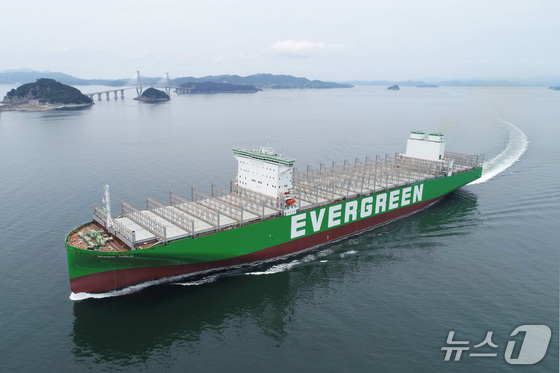
For this demonstration, a 15,000 twenty-foot equivalent unit (TEU) container ship (1 TEU equals one 20-foot container) from Taiwan’s Evergreen Marine Corporation was used. The SAS-equipped vessel conducted functional tests from August 25 to September 6, navigating a Pacific route from Oakland, California, to Kaohsiung, Taiwan.
The test results were impressive: SAS successfully navigated approximately 10,000 km (about 6,200 miles) without crew intervention, arriving precisely at the estimated time of arrival (ETA). During the journey, the system analyzed weather conditions every three hours, executed 104 optimal guidance actions, and performed 224 instances of automatic ship control, resulting in significant fuel savings.
In maritime transport, failing to meet estimated arrival times due to adverse weather or other variables can lead to substantial losses for shipping companies, causing supply chain disruptions and increased logistics costs. This emphasizes the growing demand for economical autonomous navigation technology that ensures accurate arrivals by analyzing weather conditions and operational circumstances in real time.
Looking ahead, Samsung Heavy Industries plans to continue its collaborative research with Evergreen on AI autonomous navigation technology, with a focus on optimizing both speed and routing to further enhance fuel efficiency.
Lee Dong-yeon, Vice President of Samsung Heavy Industries’ Shipbuilding and Marine Research Institute, highlighted the evolution of SAS: Their system has evolved from an autonomous navigation assistance system for collision avoidance to one that maintains economical speeds while ensuring timely arrivals. He added that this technology will make a significant contribution to the global shipping and logistics industry as an environmentally friendly means of achieving substantial fuel savings.