

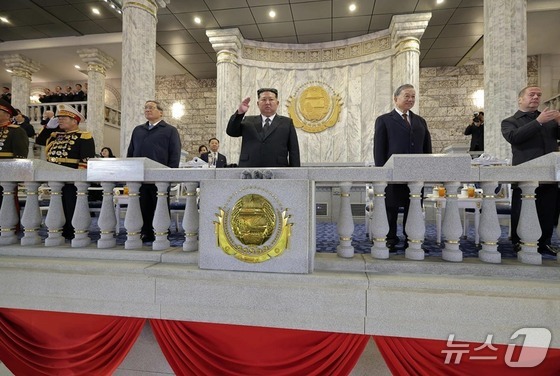
North Korean leader Kim Jong Un refrained from directly criticizing or threatening South Korea and the United States during the 80th anniversary celebration of the Workers’ Party’s founding. Instead, he unveiled the new intercontinental ballistic missile (ICBM) Hwasong-20, touting it as a supreme nuclear strategic weapon capable of striking the U.S. mainland. Kim also underscored North Korea’s alliances with China, Russia, and Vietnam to highlight the country’s strategic position.
Experts interpret this move as a strategy to bolster ties with allied nations and cement North Korea’s international status as a nuclear power, rather than a pursuit of dialogue or improved relations with the U.S. and South Korea.
Kim Flanked on the Reviewing Stand by China’s Second-in-Command and Vietnam’s Top Leader
The Workers’ Party’s official newspaper, Rodong Sinmun, reported on October 11 that Kim had attended the anniversary parade held the previous day in Pyongyang’s Kim Il Sung Square.
In his address, Kim declared that the military must continue to evolve into an invincible force that eliminates any threats to the defense rights through superior political ideology and military technology. He added that the party and the government of the Democratic People’s Republic of Korea will fulfill our responsibilities in the collective struggle of progressive humanity to oppose injustice and hegemony, and to safeguard justice and peace.
Kim’s speech reaffirmed the commitment to strengthen national defense capabilities against external threats while outlining plans to solidify North Korea’s global standing through alliances with anti-U.S. nations like China and Russia. Although he avoided direct messages to Washington or Seoul, his intent to engage in diplomacy countering both countries suggests a reluctance toward dialogue or improving relations.
During Kim’s speech, Chinese Premier Li Qiang sat to his right, while Vietnamese Communist Party General Secretary Nguyen Phu Trong was positioned to his left. Next to Trong sat Dmitry Medvedev, Deputy Chairman of Russia’s Security Council and a close ally of President Vladimir Putin. This seating arrangement underscores North Korea’s strong current ties with these nations.
The South Korean government described the attendance of high-ranking officials from various countries at North Korea’s party founding anniversary as unprecedented and extraordinary. For Pyongyang, orchestrating such a diplomatic spectacle enables it to project an image of enhanced international status compared to previous years.
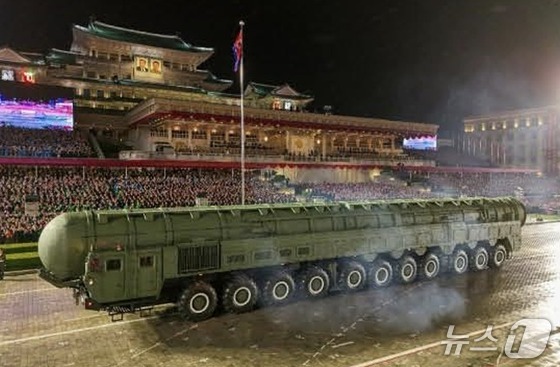
Flexing Military Muscle with Supreme Nuclear Weapons Ahead of Trump’s APEC Visit to South Korea
North Korea showcased the new ICBM ‘Hwasong-20’ during the parade, branding it as a supreme nuclear strategic weapon system. This follows last year’s presentation of the Hwasong-19 as the final version of its ICBM program.
North Korea’s ICBMs are designed to target the U.S. mainland. While Kim refrained from directly threatening the U.S. in his speech, the display of supreme nuclear weapons appears aimed at emphasizing North Korea’s nuclear status ahead of President Donald Trump’s visit to South Korea for the Asia-Pacific Economic Cooperation (APEC) summit later this month.
North Korea described the Hwasong-20 as a next-generation ICBM, indicating that the launch vehicle incorporates heat-resistant and lightweight materials, such as carbon fiber composites, and will likely use solid fuel. Given North Korea’s history of following weapon unveilings with test launches, there is speculation about a possible Hwasong-20 test before President Trump’s visit.
In a key speech to the Supreme People’s Assembly last September, Kim suggested that dialogue might be possible if the U.S. abandons its denuclearization stance and recognizes North Korea as a nuclear state. A test launch of the Hwasong-20, considered a high-intensity military provocation alongside nuclear testing, could be seen as North Korea’s unilateral declaration of its nuclear power status—even without official U.S. recognition.
Yang Moo-jin, a professor at the University of North Korean Studies, observed that with the Hwasong-20 unveiled at this parade, North Korea could conduct a test launch at an opportune moment to increase pressure on the U.S. and enhance its bargaining power. However, given Trump’s ongoing willingness for U.S.-North Korea engagement, they are likely to explore conditions and opportunities without unnecessarily escalating tensions.